


Xijiang: A Thousand Miao Households Lit Up at Dusk
The lights do not come on all at once. At Xijiang Miao Village they arrive in ones and threes, window by window, until both hillsides above the Baishui River are speckled amber and the valley floor turns the colour of a struck match.
Xijiang Qianhu Miao Village is the largest Miao settlement in China, a working village of timber stilt houses stacked up two hillsides in Leishan County, Guizhou, about 20 kilometres from Kaili. The fastest route in is a 40-minute high-speed train from Guiyang North to Kaili South, then a 40 to 50-minute shuttle. Arrive by late afternoon in October and the famous night view costs you nothing but patience.
At jusha.travel, we love sharing tips that turn a postcard into a place you actually understand: what a ticket covers this autumn, where locals stand to watch the lights, and how to slip behind the souvenir street into the village that still works for a living.
What is Xijiang Qianhu Miao Village?
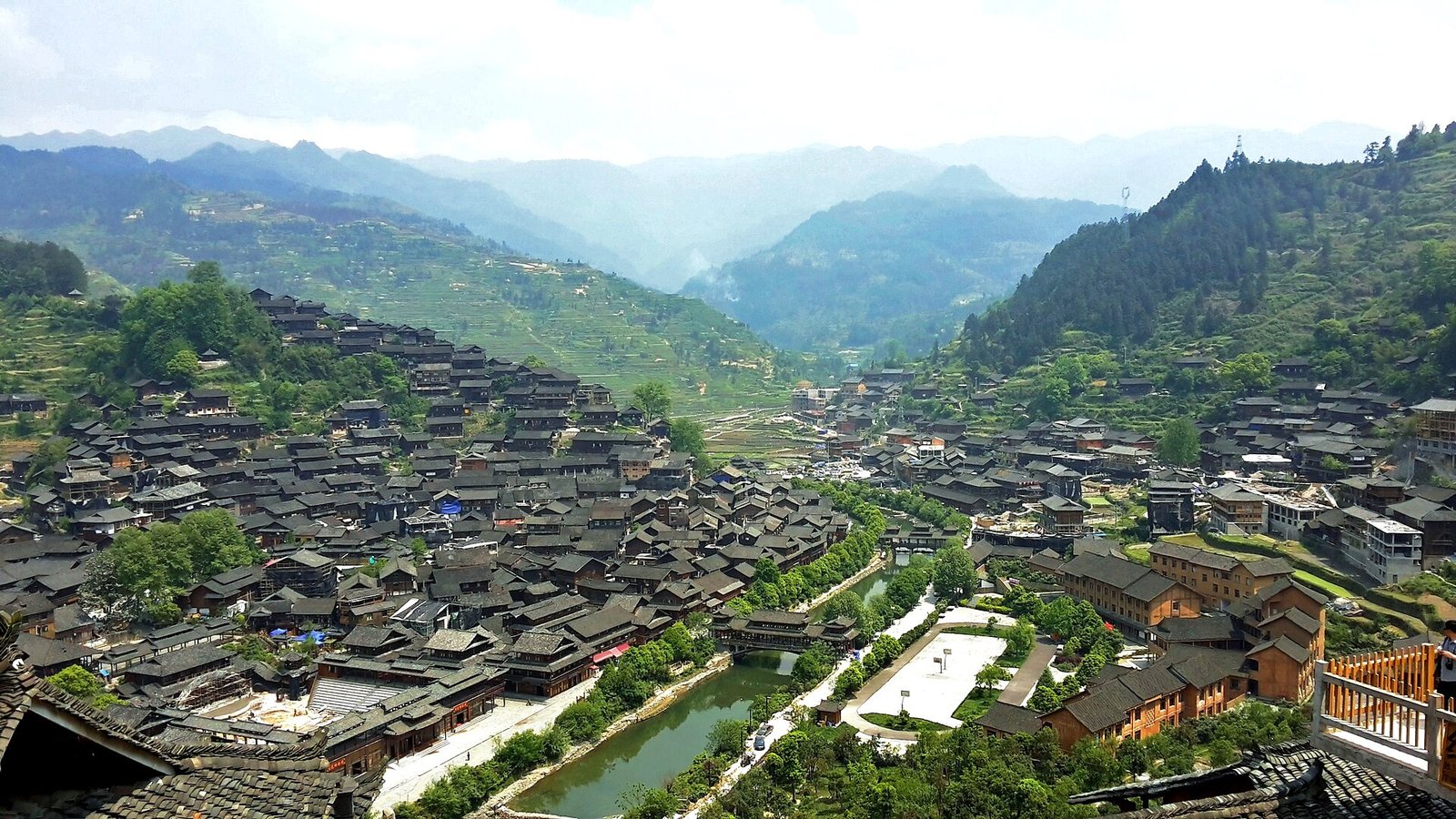
Xijiang Qianhu Miao Village is a living Miao settlement of 1,468 households and more than 6,000 residents, 99.5 per cent of them Miao, 12 kilometres northeast of Leishan in Qiandongnan Miao and Dong Autonomous Prefecture (Xijiang scenic area, official site, accessed October 2026). “Qianhu” means a thousand households, and the count is not marketing.
Behind it rises Leigong Mountain, the main peak of the Miao Ridge at 2,178.8 metres, a national nature reserve and forest park of some 71,000 hectares (China National Radio, 30 August 2017). The Baishui River runs through the valley floor under seven covered wind-and-rain bridges, and the houses climb away from it in tiers because flat ground here is a luxury nobody has.
How do you get to Xijiang Miao Village from Guiyang?
High-speed trains run from Guiyang North to Kaili South in about 40 minutes, and a direct shuttle from the station forecourt reaches the gate in another 40 to 50 minutes for 35 yuan (China Daily, 25 June 2026). Trains are booked with your passport, so read our guide to navigating China’s high-speed rail like a pro first.
A Qianshuang Bus runs direct from Guiyang North for about 139 yuan return, the airport is roughly three hours by road, and self-drive from Guiyang covers 210 kilometres in 2.5 to 3 hours.
| Route | Time | Cost | Notes |
|---|---|---|---|
| Guiyang North → Kaili South | About 40 min | From about 55 yuan | Rail |
| Kaili South → village gate | 40 – 50 min | 35 yuan | Shuttle leaves when full |
| Qianshuang Bus | 2 – 2.5 h | About 139 yuan return | Direct, no transfer |
| Guiyang airport by road | About 3 h | Varies | Agree the fare first |
What do tickets and opening hours cost in 2026?
A standard adult ticket to Xijiang Miao Village costs 90 yuan as of October 2026, with the internal shuttle separate at 20 yuan for four rides; most visitors buy the 110-yuan combination (scenic area ticket page; People’s Daily national media platform, 2026). The ticket is multi-day, so one purchase covers a slow two-night stay rather than one rushed afternoon.
Hours run 07:00 to 01:00 the next morning from 1 April to 31 October, and 07:30 to 24:00 from 1 November to 31 March. Guizhou also waives first-gate tickets at state-owned A-level sites in 2026 for students, visitors aged 65 and over, teachers, medical staff, military and police personnel and disabled visitors, with Xijiang’s 90-yuan gate inside that scope (Yanzhao Evening News, citing the Guizhou Provincial Department of Culture and Tourism, 26 June 2026). Bring the original document; the discount is checked at a window.
| Item | Price (2026) | Worth knowing |
|---|---|---|
| Adult entrance | 90 yuan | Valid several days |
| Shuttle pass | 20 yuan | Four rides; single ride 5 yuan |
| Entrance + shuttle | 110 yuan | The sensible default |
| Cableway | 30 yuan one way | 50 return; hours changed in October 2026 |
When is the best time to visit Xijiang?
Late October is the sweet spot: the rice is cut, the buses have thinned, room rates fall and the full summer timetable runs until 31 October. Autumn also brings the clearest dusk skies of the year.
Miao New Year and the lusheng gatherings fall in late autumn and winter, on dates set by local reckoning, so confirm dates before booking.
Where do you stand for the lights at dusk?
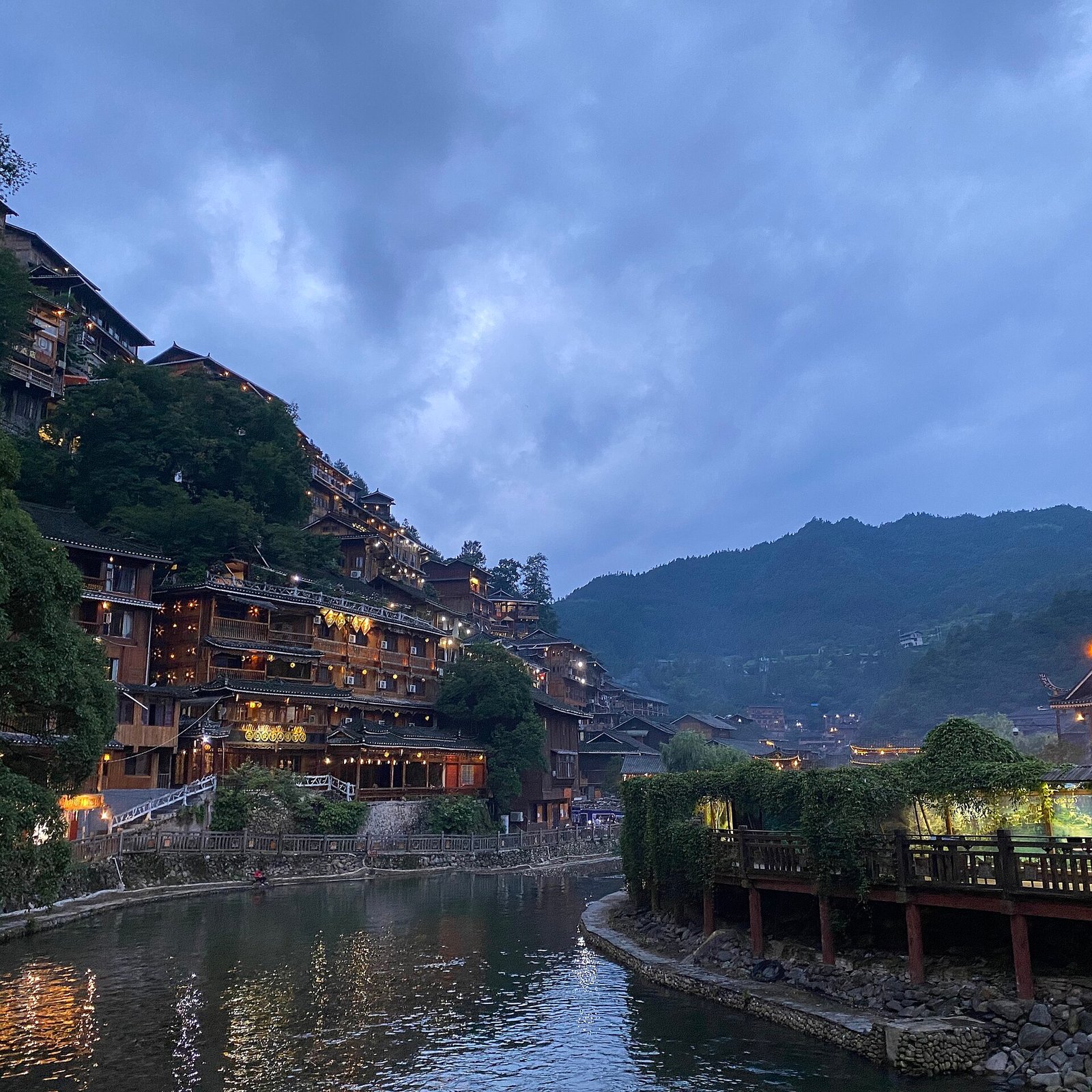
The main viewing platform on the west bank, reached by shuttle from Bridge No. 1, gives the classic angle across both hillsides, and in late October the windows glow between about 19:00 and 21:00. Arrive by 18:15 to hold a railing spot.
Two quieter platforms sit on the east bank, which the People’s Daily guide notes see far fewer visitors, while rooftop restaurants sell the same view with a bowl of sour soup attached. The west platform is the icon; the east side is where you hear the river.
| Viewpoint | View | Crowds | Best for |
|---|---|---|---|
| West bank main platform | Panorama of both slopes | Heavy after 18:00 | The classic shot |
| East bank platforms | Across to the lit western slope | Light | Tripods, quiet |
| Rooftop restaurants | Elevated, partly obstructed | Book ahead | Dinner with the view |
What happens between the bridges after dark?

The seven wind-and-rain bridges are the village’s living rooms, filling after dusk with grills, fruit stalls and children running their length. Bridge No. 1 carries the traffic up to the platform; two bridges upstream, the noise drops by half.
Dinner is where Xijiang performs itself best. A long table banquet costs roughly 68 to 99 yuan per person on top of entry, and the sour soup fish at its centre — river fish simmered with tomato, chilli and the lemony hit of litsea — is the dish Guizhou is judged by. If a host offers the high-mountain wine cascade, declining politely is entirely normal.
Why do the houses climb the hillside?

Every diaojiaolou here is a timber frame pegged and mortised without a single nail, stilted on the downhill side so a level floor can sit on a 30-degree slope (China Daily, 23 June 2026). The village reads as architecture and geology at once.
Guizhou has nearly 170 documented Miao costume systems, and Leishan is officially titled China’s Miao Silver Ornament Township; Xijiang now hosts 225 registered photography studios dressing visitors in reproduction silver and embroidery (China Daily, 2026). The Miao Museum’s 11 galleries tell that story properly, though the scenic area listed it as closed for works in September 2026.
Is Xijiang Miao Village too commercialised?
Partly, yes, and it is worth saying so. A China Daily reporter who toured some 50 historic towns wrote in August 2026 that most houses in Xijiang have become guesthouses, restaurants and shops, and found remoter villages such as Tianmen and Suojia more compelling (China Daily Chinese edition, 4 August 2026).
The counter-argument is in the numbers: more than 5.3 million visitors in the year to mid-2026 and 591 million yuan of tourism revenue, up 10.82 per cent, in a county poor within living memory (China Daily, 23 June 2026). Behind the souvenir street, people still cut rice, hang chilli and complain about the weather. Our overview of China’s minority cultures puts that trade-off in a wider frame.
How do you get past the crowds?
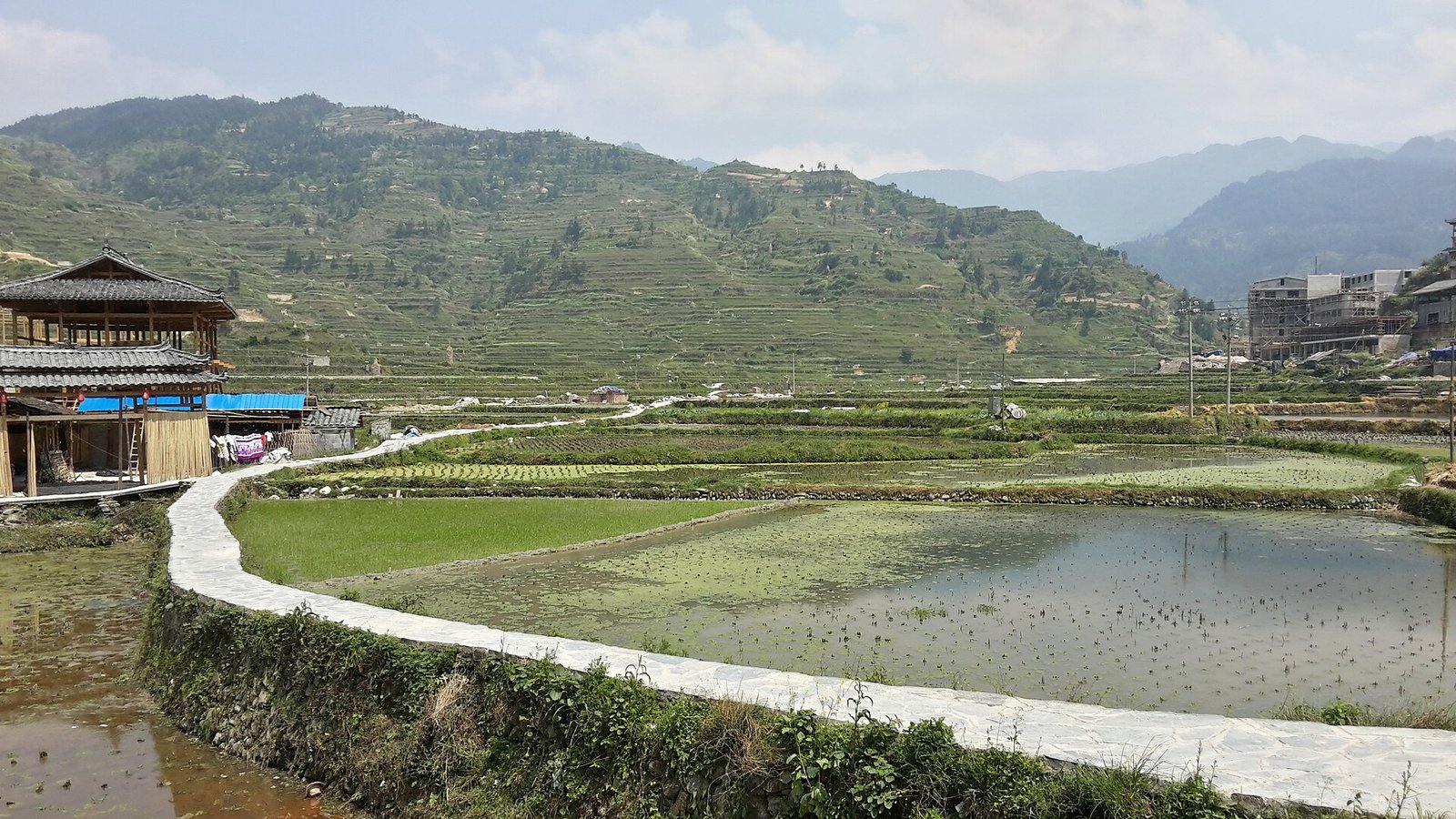
Sleep inside the village. Almost everyone arrives around 10:00, climbs to the platform at sunset and leaves by 21:00, which leaves you two clear windows: dawn, and the hour after the last shuttle.
- Book a guesthouse in Yedong or on the upper lanes, and ask them to carry your bag — no cars reach the door.
- Walk the east bank at 07:00, when the only people out are women carrying vegetables and mist is still sitting in the valley.
- Follow the Gage ancient lane behind the main street, where the shops turn back into kitchens.
- Cross Bridge No. 1 to the farmland terrace viewpoint and frame the roofs against rice stubble.
- Climb the back-hill stone path in the late afternoon instead of queueing for the shuttle.
- Eat at 17:30, take the platform at 18:30 and walk downhill while everyone else hunts a taxi.
Practical tips for a first visit
- Pack for steps. The lanes are steep and slippery after rain; wheeled luggage is a liability.
- Expect a 10°C swing. October days are mild; the platform after dark is cold.
- Ask before photographing people. Costumes and silver are cultural property, not props.
- Read the gate notice. The Great North Gate’s twelve-toast welcome was suspended on 20 October 2026, so check before counting on it.
Is Xijiang worth it?
Yes — but go for the dusk, not the checklist. Xijiang Miao Village is at its best in the twenty minutes when the tour groups are eating and the hillside starts to switch itself on, and at its worst at midday in the souvenir street. Give it two nights and it shows you what the photographs keep missing: a thousand households is not an attraction, it is a neighbourhood.
Our guide to Guizhou’s traditional villages covers quieter alternatives within a day’s drive, and our piece on Tongren’s Miao festival culture explains what those festivals mean to the people who keep them. Tell us which hour of the day won you over — we read every comment.
Frequently asked questions
How do you get to Xijiang Miao Village from Guiyang?
Take a high-speed train from Guiyang North to Kaili South in about 40 minutes, then a direct shuttle 40 to 50 minutes to the gate for 35 yuan. A Qianshuang Bus runs direct from Guiyang North for about 139 yuan return.
How much does it cost to visit Xijiang in 2026?
Entrance is 90 yuan and the shuttle pass is 20 yuan, so most visitors pay 110 yuan. The ticket covers several days, and Guizhou’s 2026 policy waives the first-gate ticket for students, over-65s, teachers, medical staff and other listed groups with the original document.
What are the opening hours at Xijiang?
Xijiang opens 07:00 to 01:00 the next morning from 1 April to 31 October, and 07:30 to 24:00 from 1 November to 31 March. Ticket checks stop at closing time, but guesthouses and restaurants inside the village keep their own hours.
What time do the village lights come on?
In late October the windows start to glow between about 19:00 and 21:00, so reach the viewing platform by 18:15 for a railing spot. The west-bank platform gives the panorama; the two east-bank platforms are quieter and face the lit western slope.
Is Xijiang Miao Village too touristy to enjoy?
It is commercial, with most main-street houses now shops and guesthouses, but it remains a working village of 1,468 households. Staying overnight, walking the east bank at dawn and following the Gage lane behind the main street puts you among residents rather than tour groups.