


Shapotou: Where the Tengger Desert Meets the Yellow River
The light turns amber first. Then the sand begins to hum. From the dune crest at Shapotou, the Tengger Desert falls away in long ripples on one side and the Yellow River slides past in a wide green bend on the other, with only a line of poplars between them.
Shapotou is a national 5A scenic area on the southeastern rim of the Tengger Desert, 16 kilometres west of Zhongwei in Ningxia. Few places on earth let you slide down a 72-metre dune, float on a 2,000-year-old sheepskin raft and walk the straw grids that taught the world to hold back a desert in one afternoon. The trip takes about 70 minutes by high-speed train from Yinchuan, then a 25-minute taxi.
At jusha.travel, we love sharing tips that turn a famous viewpoint into a real day out: how to get there without a tour, what tickets cost this autumn, and why those wheat-straw squares matter more than any photo.
What is Shapotou, exactly?
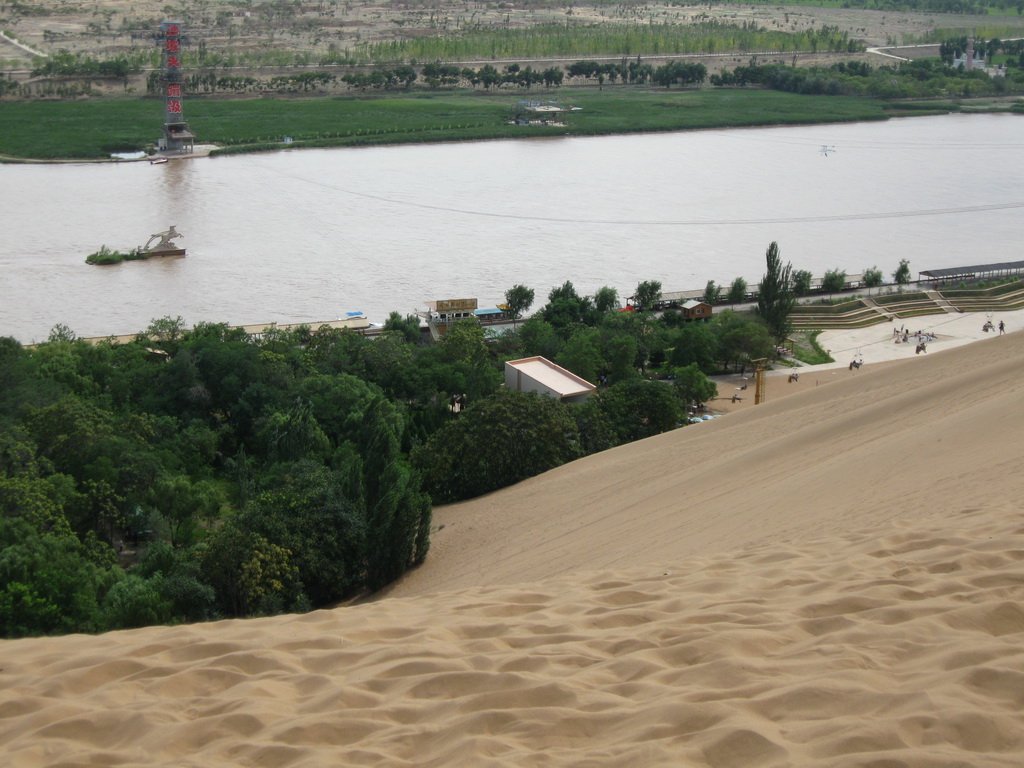
Shapotou is a 4,599-hectare national scenic area and desert nature reserve where the Tengger Desert drops straight into the Yellow River, 16 kilometres west of Zhongwei in Ningxia (Beijing Review, 7 June 2022). The site sits on the river’s south bank between 1,300 and 1,500 metres above sea level.
A single dune ridge separates a green, irrigated riverbank from open sand sea, so within a few hundred metres you walk from waterwheels and willows into dunes running unbroken towards Inner Mongolia. The area splits into a river zone in the south and a dune zone in the north, linked by a paid shuttle; walking between them is not realistic.
How do you get to Shapotou from Yinchuan?

The fastest way to reach Shapotou is a high-speed train from Yinchuan to Zhongwei South, which takes roughly 70 minutes, followed by a 25 to 30-minute taxi to the gate. The 212-kilometre Yinchuan–Zhongwei line opened in December 2019 at 250 km/h and cut the trip from 2 hours 45 minutes to about 1.5 hours (China Daily, 30 December 2019).
Yinchuan is the natural gateway, and a few direct trains link Hedong Airport to Zhongwei South in about 66 minutes. Book with your passport number, and read our guide to navigating China’s high-speed rail like a pro first.
| Route | Time | Good to know |
|---|---|---|
| Yinchuan station → Zhongwei South | 1h 05 – 1h 20 | Around 37 departures daily |
| Hedong Airport → Zhongwei South | About 1h 06 direct | Only a few services a day |
| Zhongwei South → scenic gate | 25 – 30 min taxi | Ride-hailing works; agree the fare |
When is the best time to visit Shapotou?
The best months for Shapotou are late September and October, when the season is still open, the air is mild, skies are clearest and summer crowds have thinned. China Daily calls May to early October ideal, and October is its cool, bright end.
Autumn also brings the year’s best value: the standard 80-yuan ticket sells at half price, 40 yuan, from 8 to 31 October 2026, and the first-gate ticket is free from 1 November to 31 December 2026 (Yinchuan News, 10 October 2026). Autumn hours run 8:30 to 17:30, with sales ending at 16:30, against 8:00–18:00 in peak season and 9:00–17:00 from November to March (China Daily, 18 August 2022).
| Season | What it feels like | Verdict |
|---|---|---|
| April – June | Mild and breezy, long daylight | Good; spring dust can haze the view |
| July – August | Fierce midday heat, dunes warm late | Go at opening or after 16:00 |
| September – October | Cool mornings, warm afternoons | Best window of the year |
| November – March | Cold, quiet, deep blue light | Cheapest; some river rides suspended |
Sand sledding on Mingsha Mountain: 72 metres of gravity
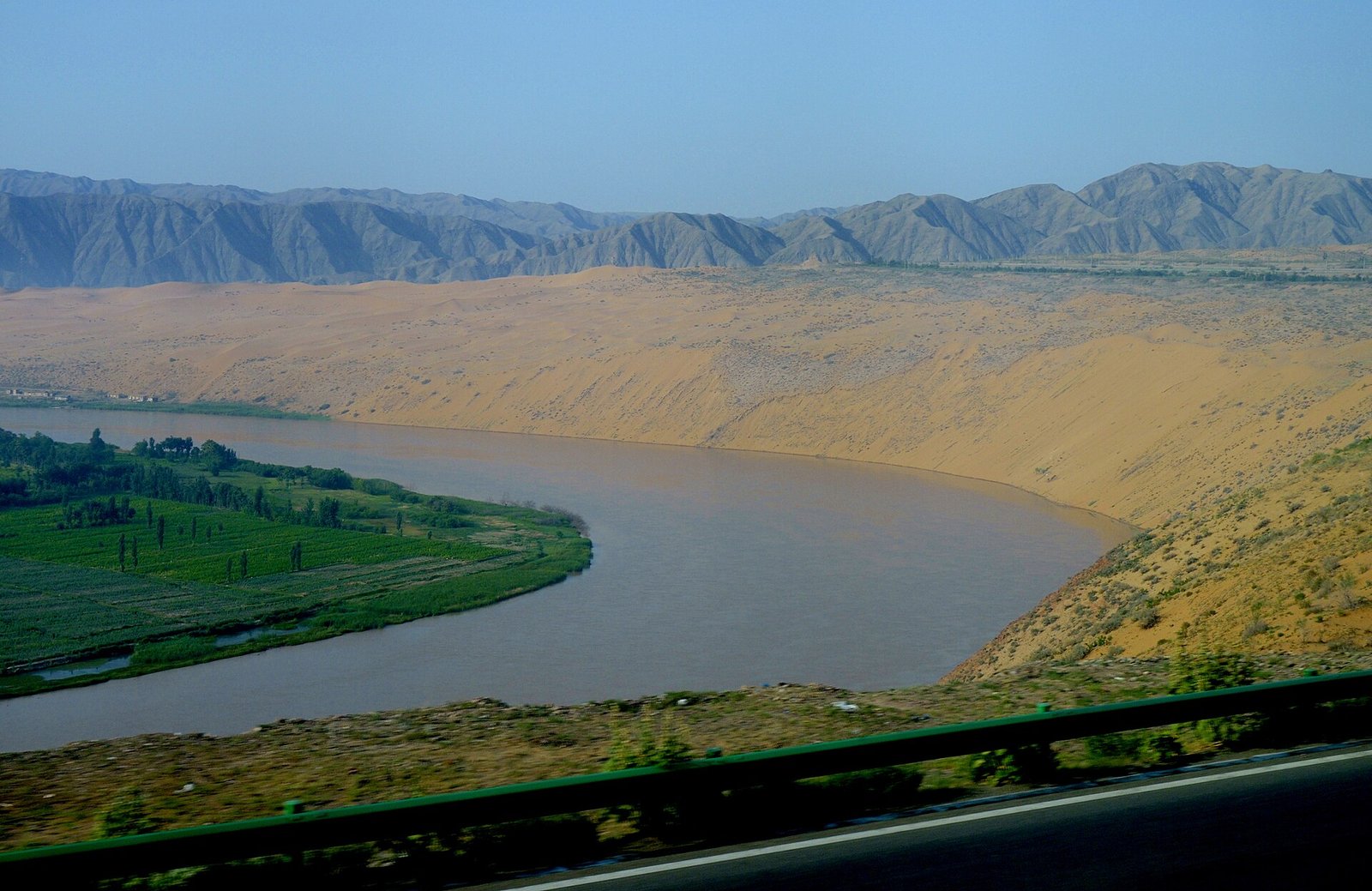
Sand sledding at Shapotou runs down a slope 180 metres long with a 72-metre vertical drop and a 35-degree pitch, the largest natural sand-sledding field in China (Beijing Review, 2022). Sleds carry brakes on both sides, so you can crawl down at a dignified pace or let go and hear the dune boom.
That sound is why locals call the ridge Mingsha, or Singing Sand Mountain: on dry afternoons the sliding grains resonate into a low bell-like hum. A free three-stage sand escalator carries you back up, which makes repeat runs tempting (Yinchuan News, 2026). Go in the first or last hour of the day, when light is better and queues are shorter.
A sheepskin raft down the Yellow River
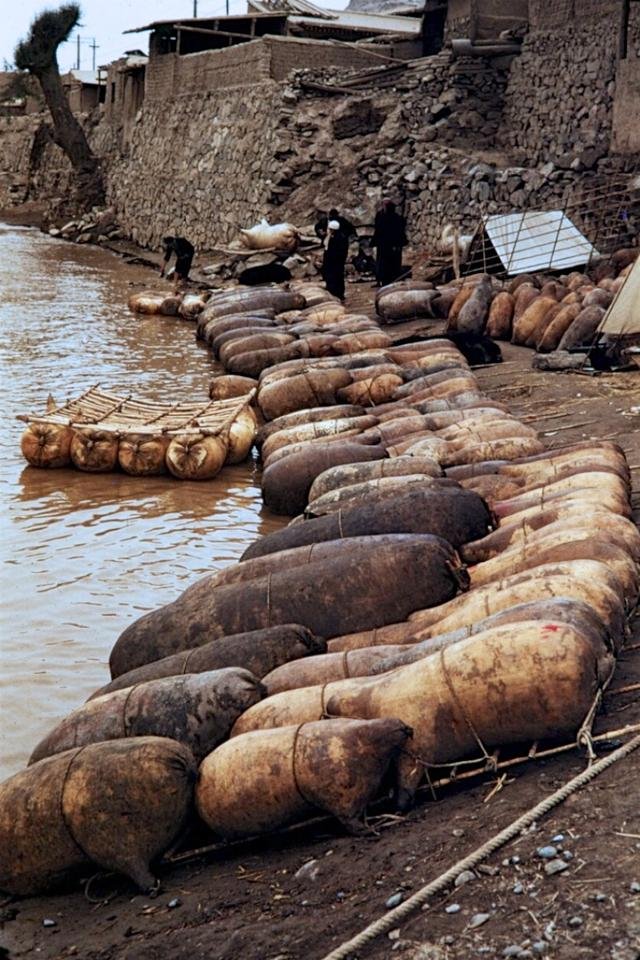
A sheepskin raft at Shapotou carries three to four passengers on roughly two dozen air-filled sheepskins lashed to a willow frame, a craft listed as key Ningxia intangible cultural heritage in 2009 (Xinhua, 11 June 2022). The design is at least 2,000 years old.
Nothing about the ride is motorised: a raftsman poles and steers while singing the flat, open melodies of the northwest, and the raft sits low enough that your hand trails in the current. The fleet numbers about 80 vessels and carries roughly 400,000 passengers between April and October, so queues move faster than they look. Strong wind shuts the rafts, which is a good reason to ride the river first on a gusty day.
The straw checkerboards that taught the world to hold sand
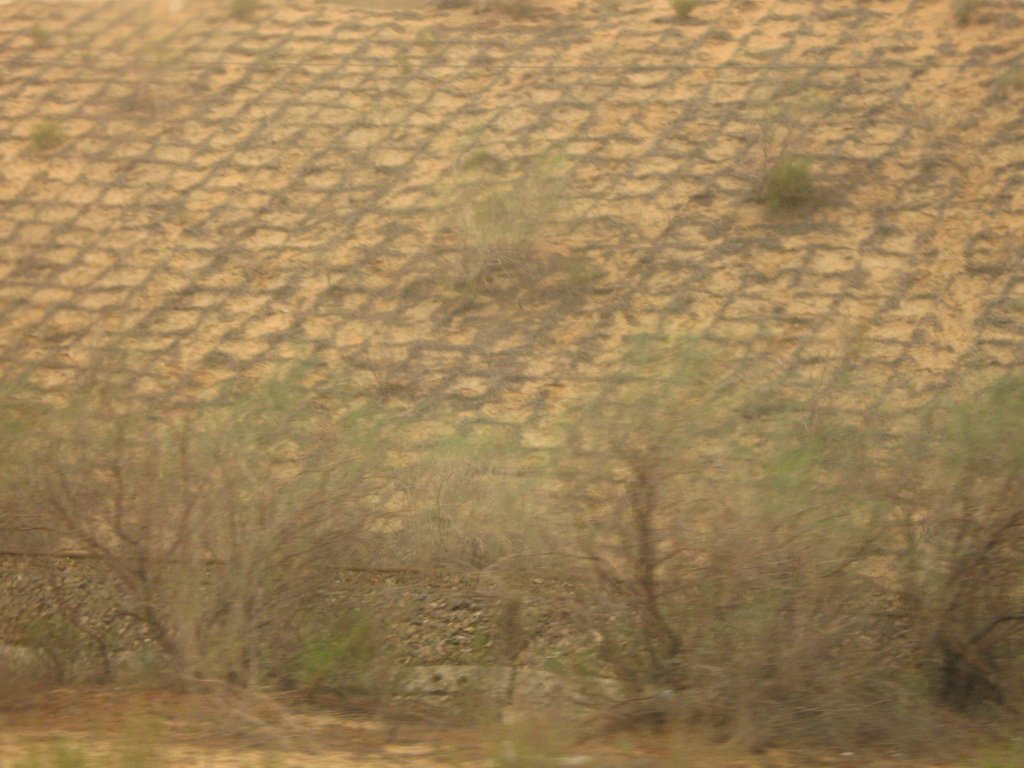
Shapotou’s straw checkerboards are one-metre squares of wheat straw pressed into the sand with a third standing proud of the surface, a technique developed here to keep the Baotou–Lanzhou railway open through the Tengger Desert (Beijing Review, 31 July 2018). Each straw sits about 10 centimetres deep and 30 centimetres tall, and the crust forming inside the grid can last more than 30 years.
The Chinese Academy of Sciences opened its first observation station here in 1955, and the railway, China’s first through a desert, opened in 1958. Around Zhongwei alone, some 10,333 hectares of sand lie under these grids, and in 1994 the UN Environment Programme gave its Global 500 Roll of Honour to the Zhongwei forestry farm. The programme has since scaled up: Ningxia has laid grids across more than 430,000 mu (about 28,700 hectares), planted over 100 million drought-resistant shrubs and pushed the desert margin back roughly 25 kilometres (Xinhua, 26 July 2026). For a parallel story of desert engineering, our piece on Yulin’s smart desert management is a natural companion read.
The grids need no guide: they line the dune-zone edges and the railway corridor, and read best from a low ridge in evening light.
What else is worth your time at Shapotou?
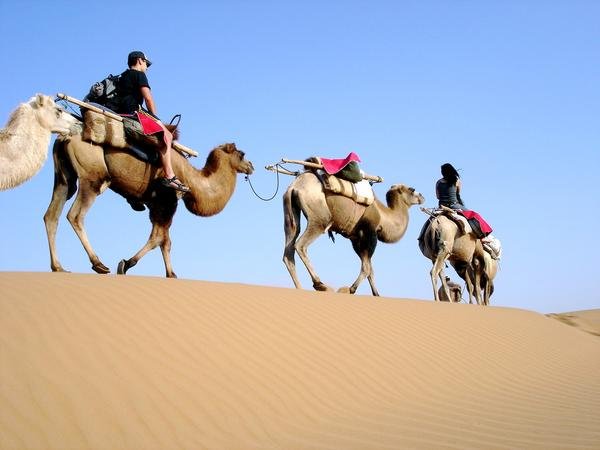
Beyond the headline rides, Shapotou offers an 820-metre zip line across the Yellow River, camel trains into the open dunes, eight-metre wooden waterwheels on the bank and a viewing platform named for the Tang poet Wang Wei (Beijing Review, 2022).
Wang Wei’s couplet about a lone plume of smoke over the desert and the setting sun over the long river is over a thousand years old, and the platform frames exactly that view.
River zone or dune zone first?
Start in the river zone at opening, when the sand slide and raft queues are shortest, then shuttle north for camels, straw grids and sunset.
| River zone (south) | Dune zone (north) | |
|---|---|---|
| Best for | Sand slide, raft, zip line, Wang Wei platform | Camel trains, straw grids, stargazing |
| Time needed | 2 – 3 hours | 2 – 3 hours |
| Watch out | Queues build sharply after 10:30 | Last shuttle back; fast cooldown after sunset |
A half-day route that actually works
- Catch an early D-train from Yinchuan, then taxi 25 minutes to the gate and buy entry plus the shuttle pass.
- Head straight for the sand slide and get two runs in before 10:00.
- Ride the escalator to the Wang Wei platform for the bend panorama.
- Float downstream on a sheepskin raft, then shuttle back to the river gate.
- Transfer north for camels, walk the straw-grid edge, and stay for sunset.
Practical tips for a first visit
- Buy the shuttle pass. The zones are not walkable and the pass is separate from entry.
- Skip cash. WeChat Pay and Alipay work at counters; foreign cards often fail.
- Cover your shoes. Cloth sand guards sold at the gate beat washing sand out of trainers.
- Work the light. Midday flattens the dunes, so shoot early or late — as we explain in why the Yellow Mountains are a photographer’s paradise.
- Check the wind. Gusty days suspend the rafts and, occasionally, the zip line.
Is Shapotou worth it?
Yes, and for reasons that have little to do with adrenalin. Shapotou compresses a whole environmental story into one view: a desert that was moving, a railway that had to survive it, and generations of researchers who answered with wheat straw and patience. The slide is fun and the raft is beautiful, but the grids stay with you. For wider context, start with our overview of China’s desert adventures from the Gobi to the Taklamakan.
Go in October if you can, arrive at opening, and give the place a full day. Then tell us what surprised you most — we read every comment and collect the details that make a return trip better than the first.
Frequently asked questions
How do you get to Shapotou from Yinchuan?
High-speed trains run from Yinchuan to Zhongwei South in about 70 minutes, and the gate is another 25 to 30 minutes by taxi. The 212-kilometre Yinchuan–Zhongwei line opened in December 2019 and cut the journey to roughly 1.5 hours (China Daily, 30 December 2019).
How much does Shapotou cost in 2026?
Shapotou’s standard adult ticket is 80 yuan, but from 8 to 31 October 2026 it is half price at 40 yuan, and from 1 November to 31 December 2026 the first-gate ticket is free (Yinchuan News, 10 October 2026). Shuttles and activities cost extra.
What are Shapotou’s opening hours?
Shapotou opens at 8:30 and closes at 17:30 in autumn 2026, with ticket sales ending at 16:30. Peak hours are 8:00 to 18:00 from April to October, and low-season hours are 9:00 to 17:00 from November to March (China Daily, 18 August 2022).
Can you see the straw checkerboards without a guide?
Yes. Straw checkerboards are visible along the dune zone’s edges and beside the Baotou–Lanzhou railway, reachable without a guide. The research station itself is a working laboratory, observed from outside.
Do you need a permit to visit Shapotou?
No permit is needed for Shapotou or Zhongwei. Foreign visitors need a valid visa and passport for train and entry tickets, and the scenic area is a commercial 5A attraction rather than a restricted reserve.