


Wulong’s Sinkholes: Descending Into China’s Karst Underworld
You learn to read the sky differently on the floor of a collapsed mountain. At Wulong it hangs 280 metres above your head as a pale ribbon, framed by the black underside of a limestone arch, and the only sounds are dripping water and your own breathing.
The Wulong karst sinkhole system lies in Wulong District, Chongqing, roughly 130 kilometres southeast of the city centre, within the UNESCO-listed South China Karst. Three natural bridges — Tianlong, Qinglong and Heilong — span two tiankeng, or collapse dolines, inside a gorge less than 1.5 kilometres long.
At jusha.travel, we love sharing tips that turn a famous viewpoint into a place you can actually read: what the numbers mean, how the train and shuttle connect, and where October light lands. This guide covers the descent, the Wulong karst sinkhole floor, and the Longshuixia Fissure next door.
What is a Wulong karst sinkhole?
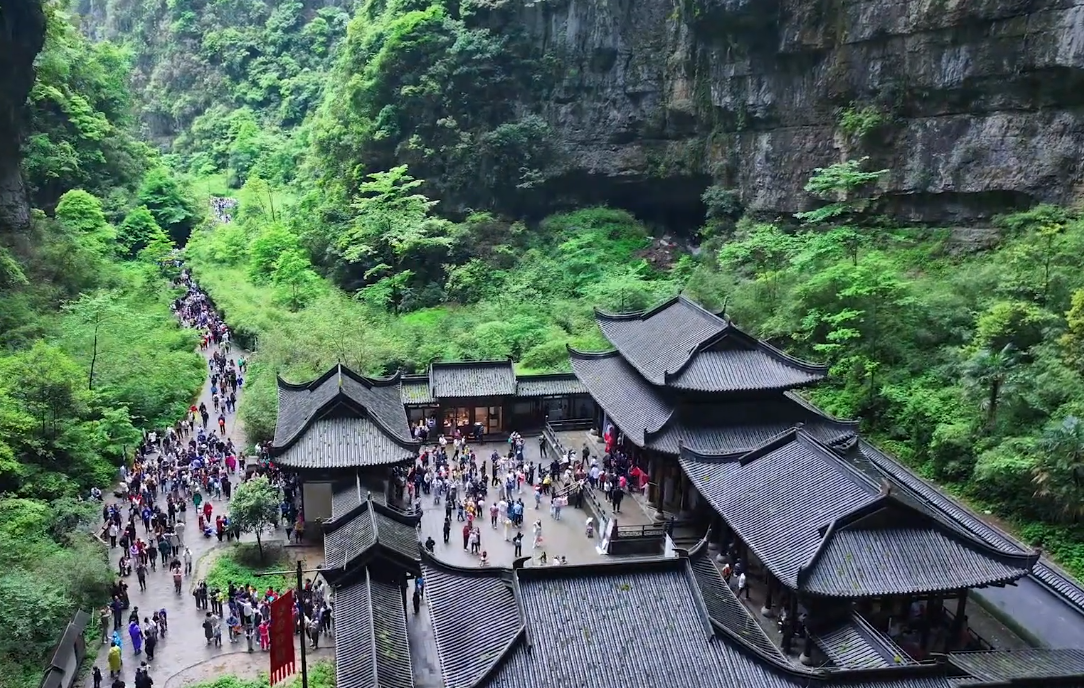
A Wulong karst sinkhole is a giant collapse doline formed when an underground river dissolved the limestone beneath a plateau until the cave roof gave way, leaving a vertical-walled pit open to the sky. Two sit beneath the bridges at Tiankeng Sanqiao, so the view reads as three arches between two pits.
UNESCO inscribed the Wulong component in 2007 for precisely this geology, citing the giant dolines and bridges as evidence of the Yangtze’s incision history (UNESCO World Heritage Centre, accessed October 2026). The core zone covers 6,000 hectares, wrapped in a buffer of 32,000.
The Chinese term is tiankeng, “sky pit”, and it is stricter than the English word sinkhole: geologists reserve it for collapses over 100 metres deep and wide. At Wulong the Qinglong and Shenying tiankeng measure 276 to 285 metres deep, with rims 300 to 522 metres around (Wikipedia, Three Natural Bridges, accessed October 2026).
| Bridge | Height | Width | Arch clearance | Span |
|---|---|---|---|---|
| Tianlong (Sky Dragon) | 235 m | 147 m | 96 m | 34 m |
| Qinglong (Azure Dragon) | 281 m | 124 m | 103 m | 31 m |
| Heilong (Black Dragon) | 223 m | 193 m | 116 m | 28 m |
Why does Wulong feel different from Zhangjiajie and Guilin?
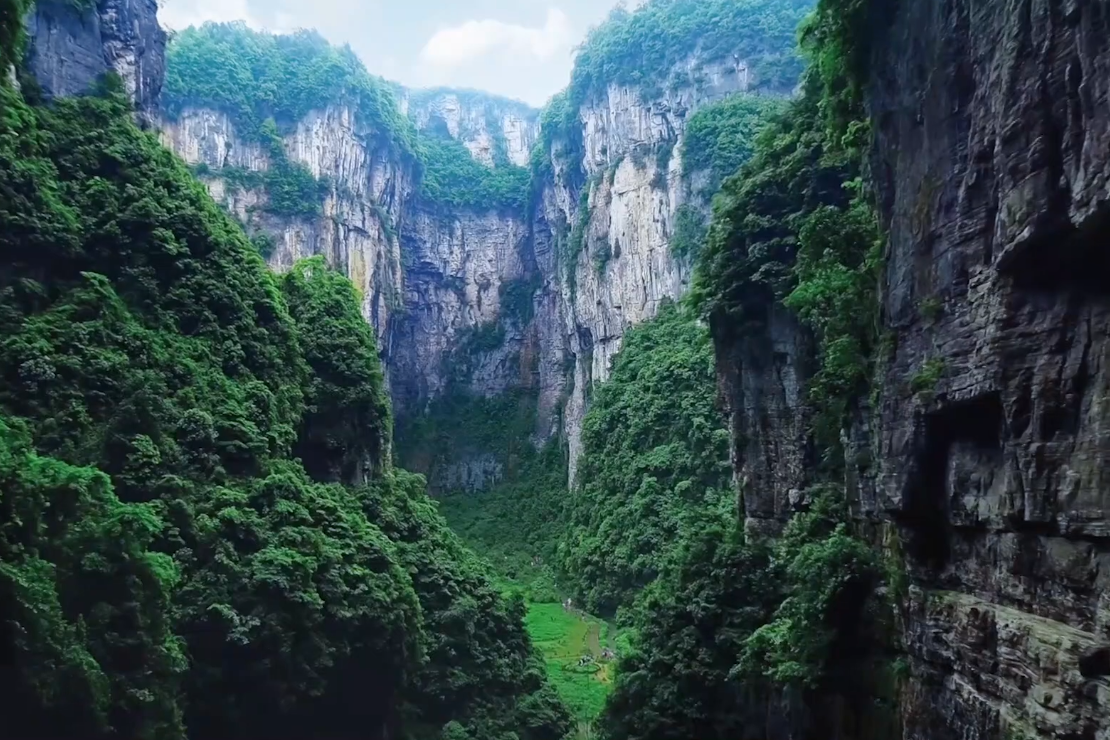
Wulong is a landscape you look up at from inside, while Zhangjiajie’s sandstone pillars and Guilin’s tower karst are landscapes you look across from outside. Wulong’s drama is vertical and enclosed: a cave roof that failed rather than a peak that survived.
Zhangjiajie is quartz sandstone, not limestone, and its peaks are erosion remnants seen from rim trails and glass bridges, which is why our guide to Zhangjiajie’s floating peaks keeps pointing you outward. Guilin sits at the other end of karst evolution, where fenglin towers rise from a river plain.
A Wulong karst sinkhole is not a mountain you climb but a room you enter. You descend by lift and stair, walk a dry valley floor between three arches, and look at the underside of a plateau.
| Landscape | Rock | Signature form | How you view it |
|---|---|---|---|
| Wulong | Limestone | Giant dolines and natural bridges | Upward, from the gorge floor |
| Zhangjiajie | Quartz sandstone | Pillar forest and cliff rims | Outward, from rim trails |
| Guilin | Limestone fenglin | Tower karst and river plain | Horizontally, from water |
How do you get to Wulong from Chongqing?
High-speed trains run from Chongqing East to Wulong South in as little as 38 to 39 minutes, and a shuttle bus then takes 30 to 50 minutes to the scenic-area visitor centres. Most travellers leave Chongqing before 08:00 and stand under the first arch by mid-morning.
- Book Chongqing East to Wulong South on the Yuxia line; second class costs 80 yuan and the fastest service takes 34 minutes (Chongqing municipal government, 26 June 2025). The line opened on 27 June 2025 (China National Radio, 18 April 2026).
- Exit Wulong South and take the green scenic shuttle rather than a taxi.
- Buy tickets at the visitor centre — bridges and fissure are separate.
- Ride the included shuttle to the gate, then the 80-metre lift down.
- Reverse it by 16:30, the last admission from September to April.
| Option | Time | Typical cost | Worth knowing |
|---|---|---|---|
| Chongqing East → Wulong South | 38 – 39 min | 80 yuan | Fastest, most reliable |
| Chongqing North → Wulong | About 2 h | 25 – 50 yuan | Slower, fewer departures |
| Wulong South → scenic area | 30 – 50 min | 10 – 25 yuan | Shuttle bus |
| Private car from Chongqing | 2.5 – 3 h | 400 – 550 yuan | Door to door |
New to Chinese rail? Read our guide to navigating China’s high-speed rail like a pro. The Wulong karst sinkhole turnstiles are still a bus ride from the station.
What does a Wulong ticket cost in 2026?
The Wulong karst sinkhole ticket costs 155 yuan per adult in peak season, March to October, including the internal shuttle and the 80-metre lift; the same package is 125 yuan from November to February. Longshuixia Fissure is separate, at 105 yuan peak and 85 yuan low season.
Those prices come from the official Wulong tourism site, which breaks the 155 yuan into a 40-yuan shuttle and a 45-yuan lift (Wulong tourism ticket page, accessed October 2026). The district government lists lower gate-only figures — 70 yuan peak, 40 yuan low — because transport sits outside them (Wulong District Culture and Tourism Commission, 4 January 2026).
| Ticket | Peak (Mar – Oct) | Low (Nov – Feb) | Includes |
|---|---|---|---|
| Three Natural Bridges | 155 yuan | 125 yuan | Entry, shuttle, lift |
| Longshuixia Fissure | 105 yuan | 85 yuan | Entry, shuttle, lift |
| Furong Cave plus cableway | 150 yuan | 135 yuan | Cave and cable car |
| Fairy Mountain | 50 yuan | 50 yuan | Grassland entry |
Hours run 08:30 to 16:30 from 1 September to 30 April, and 08:00 to 17:00 from June to August (same list). Budget for two Wulong karst sinkhole tickets only if you add the fissure.
How long does the Three Natural Bridges walk take?
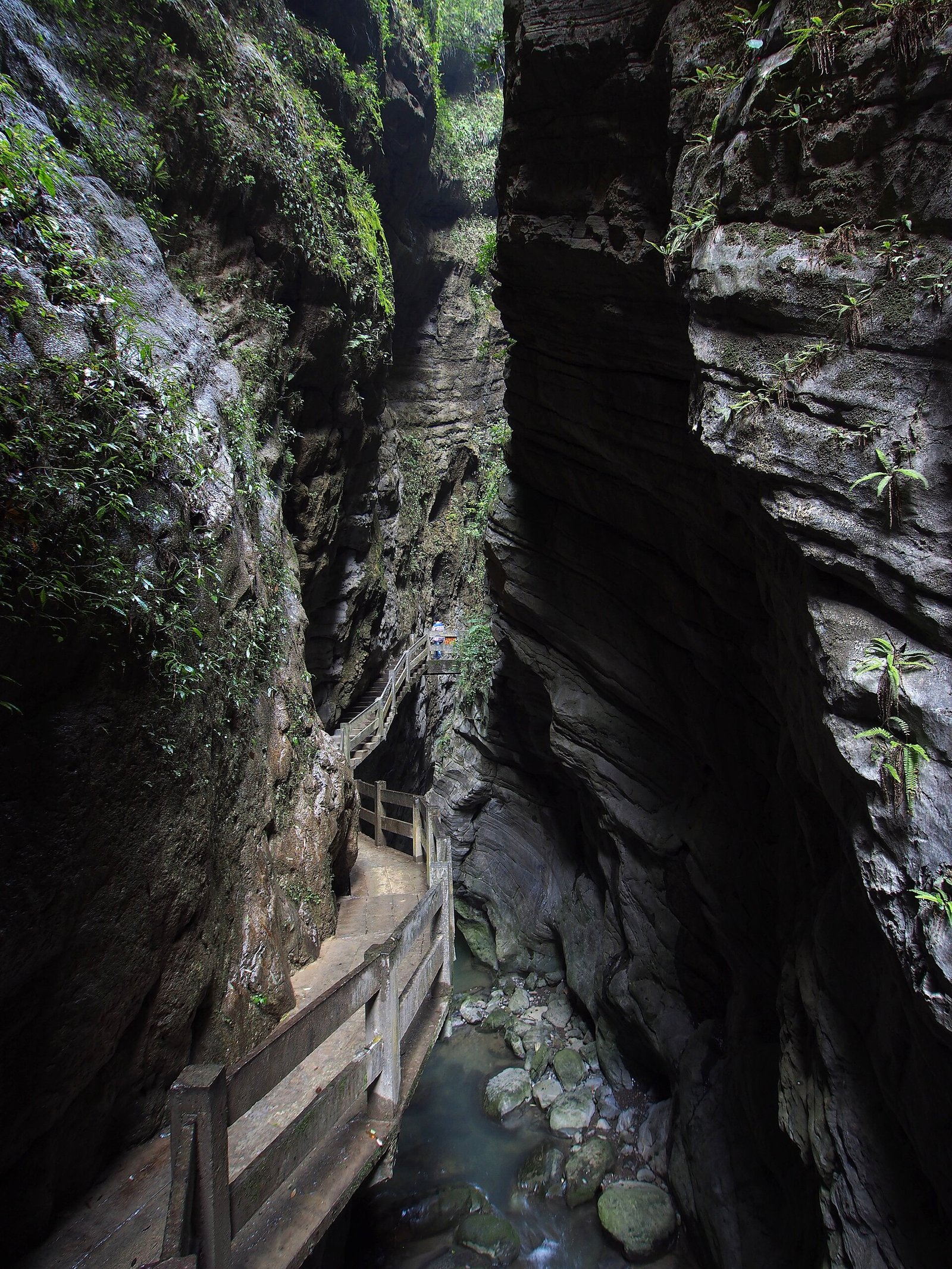
The Wulong karst sinkhole walk takes two to three hours and covers roughly three kilometres one way, almost all of it flat or gently descending, with a lift at the start and an optional 15-yuan electric cart at the exit. The route is one-way, so you never retrace your steps.
About 300 metres of elevation separates rim from floor, but the lift absorbs most of it. The floor stays damp and shaded, so grip matters more than stamina.
Unlike the Wulong karst sinkhole circuit, the Longshuixia Fissure never opens out. It is a 5-kilometre fault fissure 200 to 500 metres deep, of which about 2 kilometres is walkable on a one-way plank path that narrows to a metre in places (Trip.com scenic listing, 2026). Waterfalls drop onto the boardwalk, including the 100-metre Galaxy Waterfall.
Allow 1.5 to 2 hours there; the fissure closes at the same 16:30 cut-off.
When is the best time to stand on the sinkhole floor?
October is the best month to stand on a Wulong karst sinkhole floor because summer haze has cleared, low sun reaches the valley in clean shafts, and National Day crowds thin after the first week. Rain is less frequent than in spring.
Light behaves predictably: shafts fall through the arch openings between about 10:00 and 14:00. Aim for a weekday in mid-October and arrive at opening.
Winter at the Wulong karst sinkhole is cheapest and quietest, but ice and rain can close the fissure boardwalk without notice, so check first.
Practical tips for a first descent
- Start at opening. The 08:30 lift queue is short; by 10:30 tour groups arrive in waves.
- Wear real grip. Stone steps stay wet under the arches all year.
- Pack a shell, not an umbrella. Spray inside the fissure makes umbrellas useless.
- Bring one wide lens. The Wulong karst sinkhole lift is the only place you want reach.
- Keep your passport handy. It is the linked ID at the gate and the station.
Is Wulong worth a day from Chongqing?
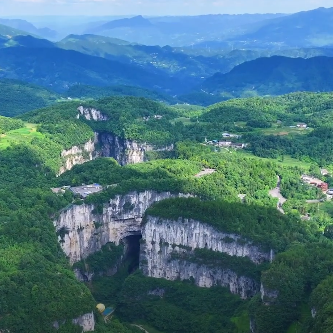
Yes, and the numbers explain why it no longer feels like a secret: Wulong’s scenic areas recorded 52.1 million visits in 2025, and 25.1 billion yuan in tourism revenue (China Daily, 13 July 2026). Two films shot here — Zhang Yimou’s Curse of the Golden Flower and Michael Bay’s Transformers: Age of Extinction — and the recognition followed (China Daily, 7 September 2024).
Go for the geometry, not the film locations. The Wulong karst sinkhole is one of the few places where you can stand where a cave roof used to be and look up at the arch that was its wall.
If you love this walking, our piece on why Yangshuo’s karst landscapes are a hiker’s paradise covers the gentler end of the same rock, and hiking in Guilin’s karst trails adds the river-plain version. Back in the city, try Chongqing mala xiangguo by the river — and tell us which won you over.
Frequently asked questions
How do you get to Wulong from Chongqing?
Take a high-speed train from Chongqing East to Wulong South in 38 to 39 minutes for 80 yuan in second class, then a scenic shuttle bus for 30 to 50 minutes to the visitor centre, where ticket desks and the lift are waiting. The line opened on 27 June 2025 and runs through the day.
How much is the Wulong karst sinkhole ticket?
The Wulong karst sinkhole ticket costs 155 yuan per adult in peak season, March to October, including the 40-yuan internal shuttle and the 45-yuan lift down into the gorge itself, and it falls to 125 yuan from November to February. Longshuixia Fissure is a separate 105-yuan ticket in peak season.
How long does the Three Natural Bridges walk take?
The Three Natural Bridges walk takes two to three hours at an easy pace over roughly three kilometres of one-way trail through the sinkhole floor, with a lift down at the start and an optional 15-yuan electric cart waiting at the exit gate. Most of the route is flat, but the stone is wet and the steps at each bridge are steep.
Is Longshuixia Fissure worth adding to the same day?
Longshuixia Fissure is worth adding to a Wulong day trip if you start at opening, because the plank path takes another 1.5 to 2 hours and the gate closes at 16:30 through the year, so it cannot be squeezed in after lunch. The route runs through a 5-kilometre fissure 200 to 500 metres deep.
When is the best time to visit Wulong?
October is the best time to visit Wulong because summer haze has cleared, low sun reaches the gorge floor in clean shafts, daytime temperatures stay mild, and the National Day crowds reliably thin after the first week of the month. Weekday mornings give the shortest lift queues.