


Yuanyang’s Water Terraces: When Mountains Turn to Mirrors
Every winter, a mountain in southern Yunnan stops behaving like a mountain and starts behaving like glass. The Yuanyang rice terraces are cut into the southern slopes of the Ailao range, drained after harvest and refilled with water, so that for about five months the sky lies in pieces down the valley. The Hani have farmed these slopes for some 1,300 years. You come for sunrise at Duoyishu, sunset at Bada, and the mushroom-roofed village of Azheke between them. At jusha.travel, we love sharing tips that save a traveller a wasted dawn, so here is the water, the light, the ticket and the road.
What makes the Yuanyang rice terraces a World Heritage landscape?
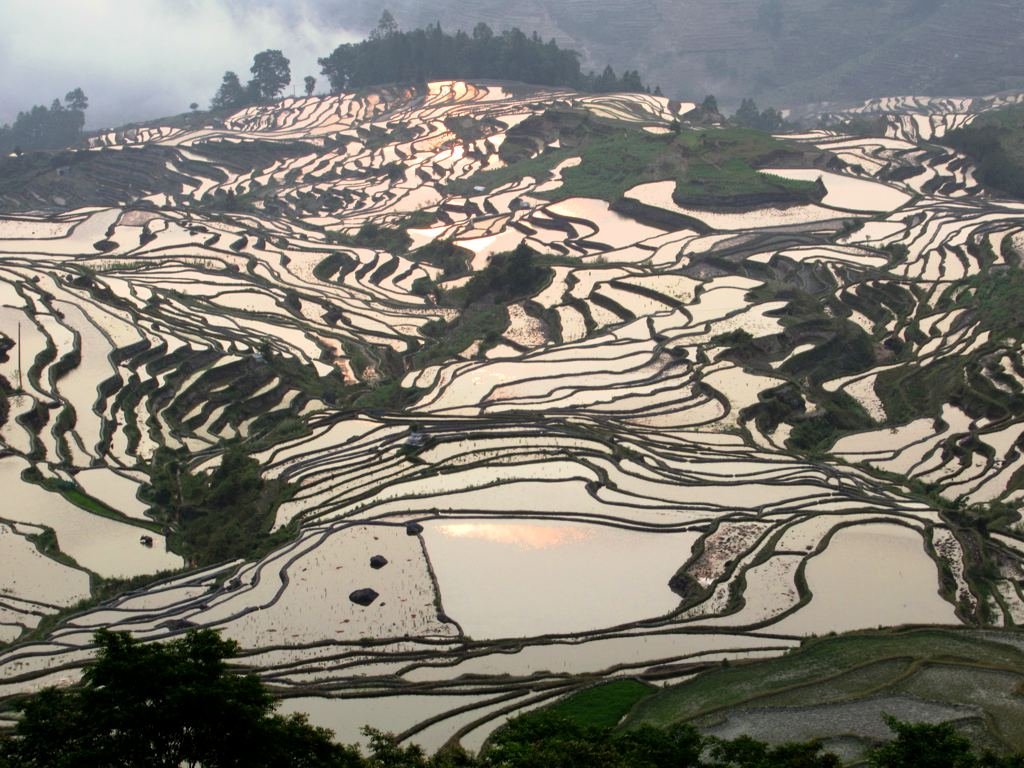
The Yuanyang rice terraces form the core of the Cultural Landscape of Honghe Hani Rice Terraces, inscribed by UNESCO in 2013 for a working farming system rather than a view. The listed property covers 16,603 hectares across four counties and protects 82 villages; Yuanyang alone holds about 190,000 mu stacked up to 3,700 levels, between roughly 1,300 and 2,023 metres.
Three groups carry almost all the traffic — Bada, Duoyishu and Laohuzui — and because the rock beneath them differs, so do their gradients: one ticket, three different photographs.
Why late November is the start of mirror season, not the peak
Terraces flood in stages, and the gap between a flooded field and a full mirror is about four weeks. Ground below 1,200 metres starts taking water in mid-November, while the high blocks around Bada and Duoyishu finish harvest later and fill from late November into early December (Yuanyang County Government, December 2024). Peak reflection, as of November 2026, runs from late December to February.
| Period | What you see | Verdict |
|---|---|---|
| Mid–late November | Patchy flooding, stubble, mist | Atmosphere, not mirrors |
| December–February | Full water, sharpest reflections | Peak; cold and crowded |
| March–mid April | Water with first green shoots | Soft light, thin crowds |
| May–September | Green rice, no reflection | Terraces read as texture |
| October | Golden harvest | Colour, hidden lines |
Duoyishu: the sunrise amphitheatre
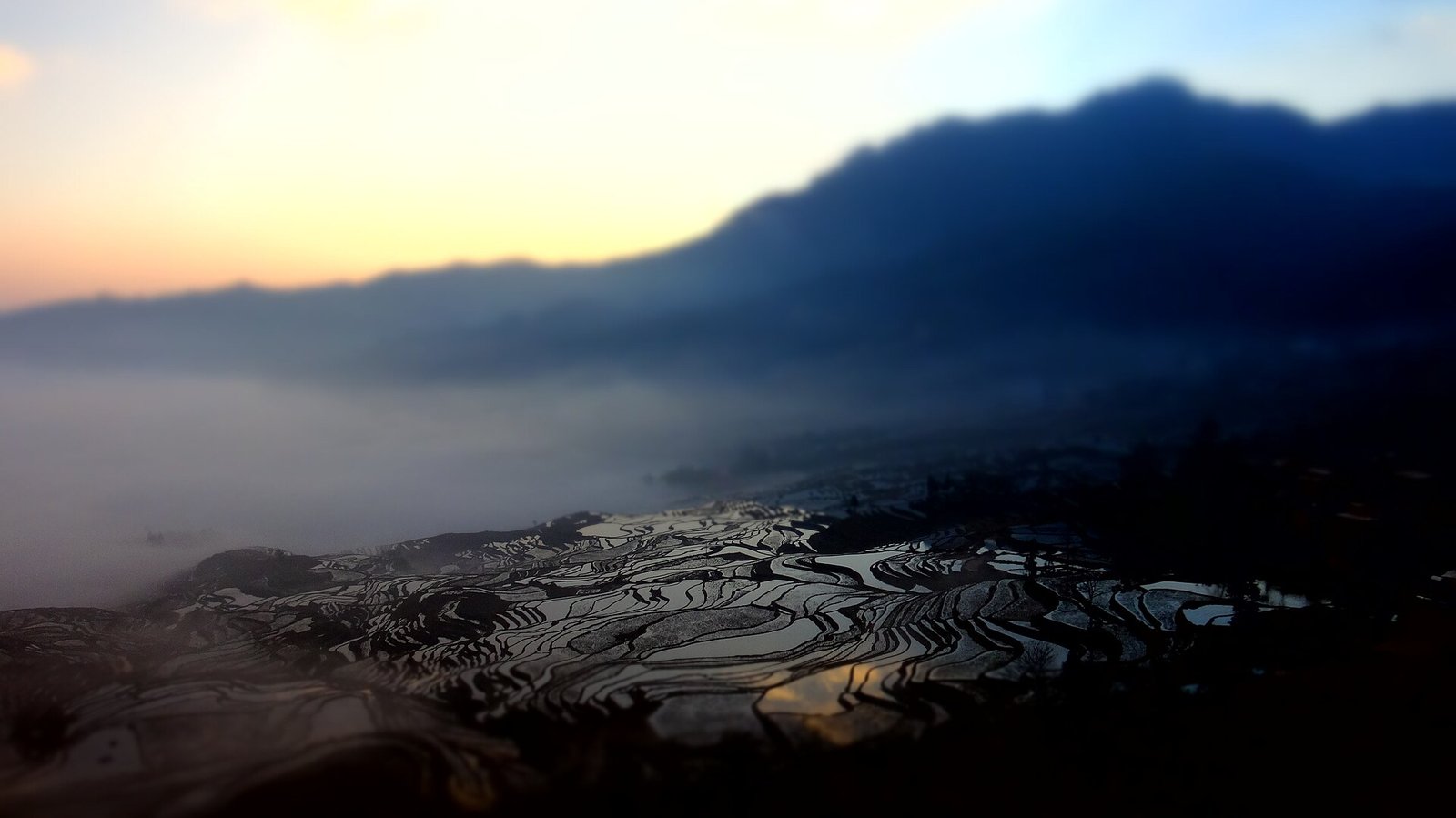
Duoyishu is the sunrise platform, 24 km east of Xinjie and 45 minutes by car, with terraces facing east at about 1,900 metres. It is the most developed viewpoint in the Yuanyang scenic area and the most crowded: on a clear winter morning the front row of tripods goes by 06:00. Sunrise in mid-November falls near 07:20, so arrive an hour early and bring gloves.
If the platform is wall-to-wall, walk 200 metres along the road for a side angle and a tenth of the people. Photographers wanting the technical version should read our guide to photographing China’s rice terraces first.
Bada: the widest staircase, and the better sunset
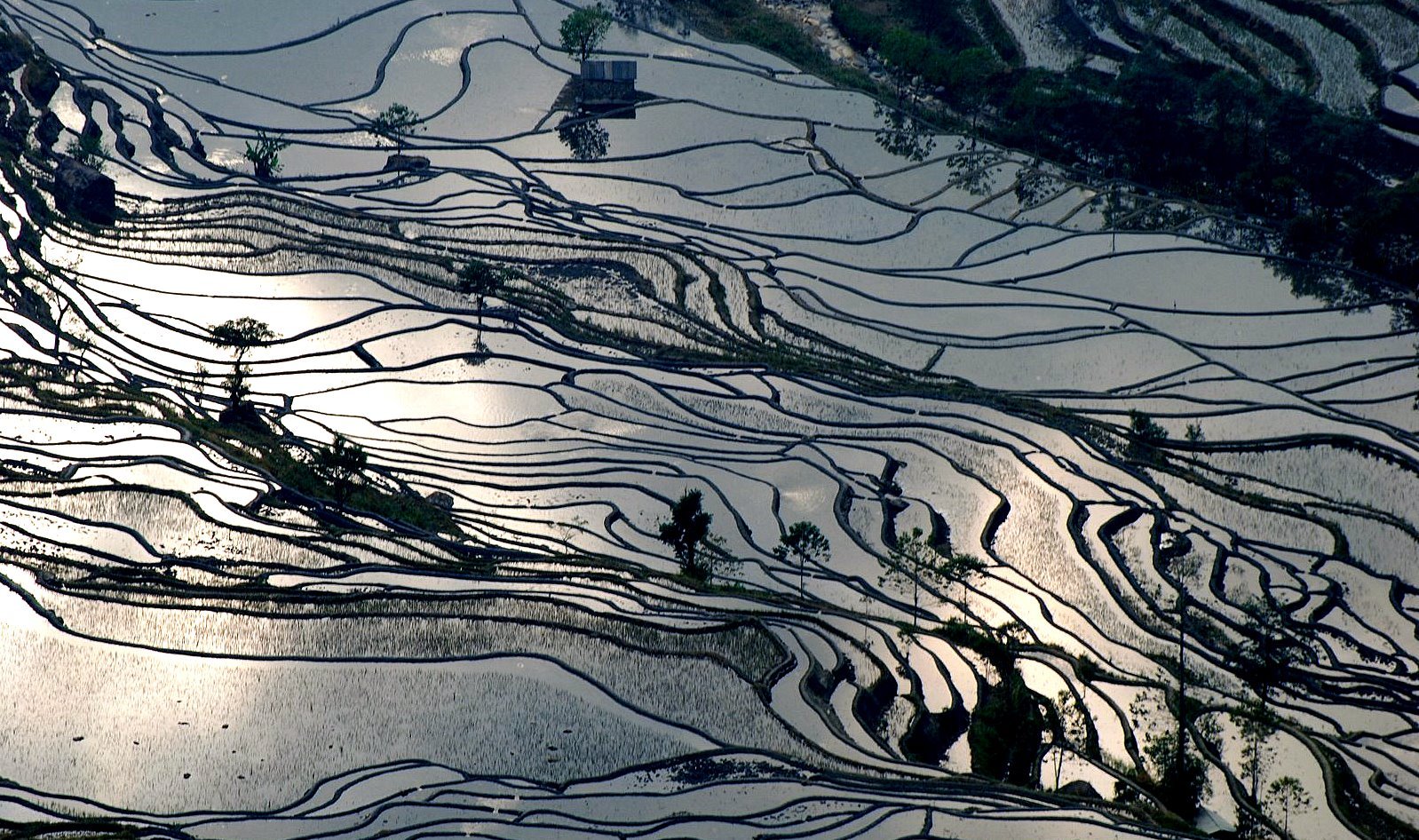
Bada is the broadest of the terrace groups, 16 km from Xinjie, and it makes the stronger sunset. Its gradient is gentle where Duoyishu is violent, which lets one frame hold more than 3,000 levels rising from about 800 metres to over 2,000 (UNESCO). Light leaves the valley around 18:20 in November, so be in place by 17:30.
Laohuzui: check before you count on it
Laohuzui, or Tiger’s Mouth, is the steepest of the three classic viewpoints, with terraces folding into a ravine on slopes above 40 degrees. It has also spent long stretches closed because of slope instability, so treat it as a bonus, not an anchor. Ask at the gate in Xinjie whether the road is open that week.
Aichun’s blue terraces: the hour nobody mentions
Aichun’s blue paddies are the stop most itineraries skip. Between about 09:00 and 11:00 on a clear, still day, water below the village takes on a hard, clean blue that looks edited and is not. There is no gate and no ticket; park at the village and walk down. It needs sun and no wind, so it fails often.
Azheke: the village that owns its own view
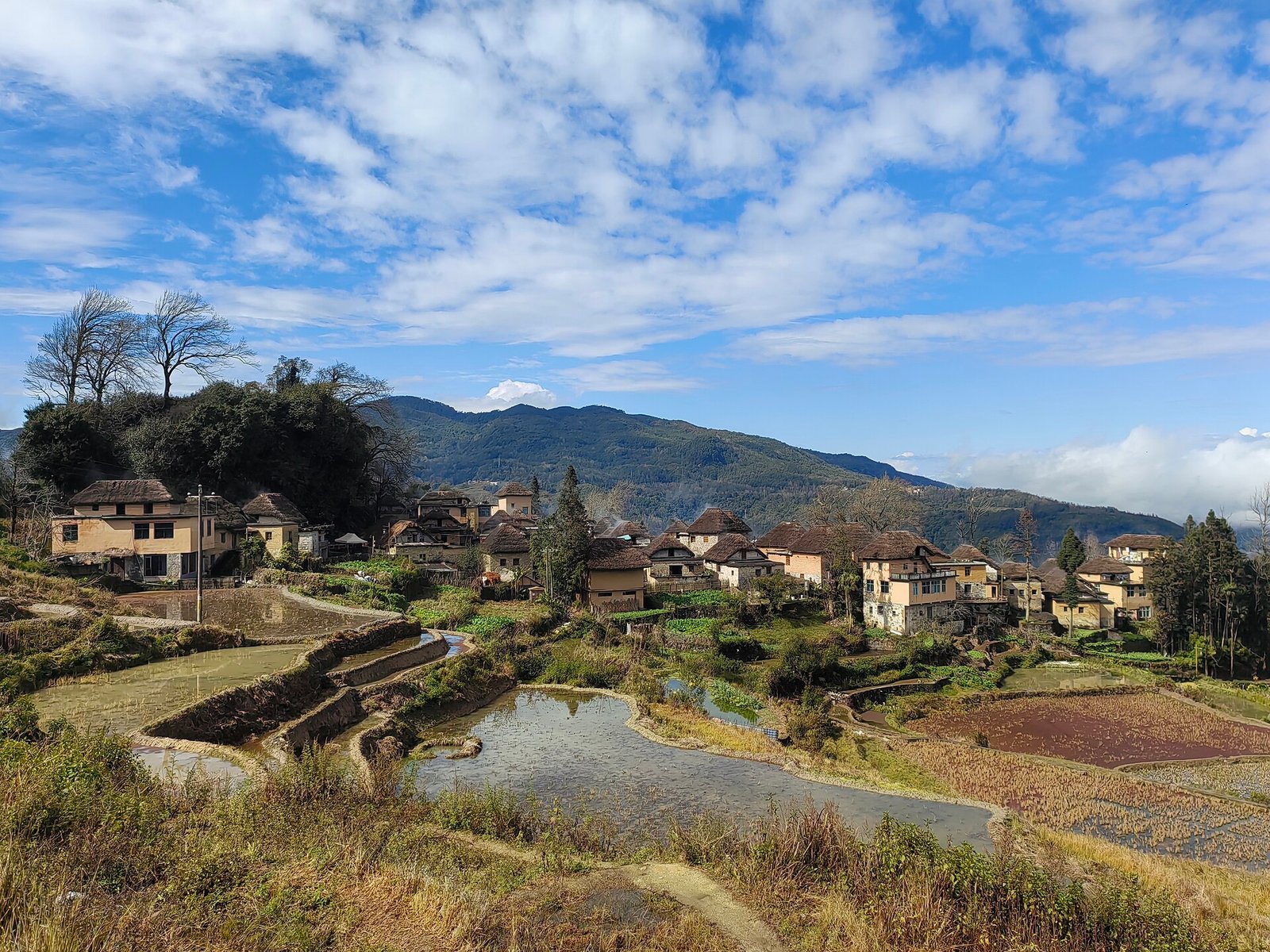
Azheke is a Hani village of 65 households, founded in 1855, and one of five key villages in the World Heritage nomination. Its mushroom houses — rammed earth walls under tall thatched roofs — sit above their own paddies, which is why so many terrace photographs carry a roof. Entry costs 30 yuan, separate from the scenic-area pass.
What makes Azheke unusual is who holds the equity: since 2018 its households have held 70 percent of a village tourism company. Profit splits 40 percent for house maintenance, 30 for terrace care, 20 for living there, 10 by household registration — so a kept roof and a worked paddy pay, and an empty second home does not. China News Service reported on 28 August 2026 that those households had shared 3.45 million yuan since 2019. UN Tourism named Azheke a Best Tourism Village on 15 November 2024.
How does the water actually reach the top terrace?
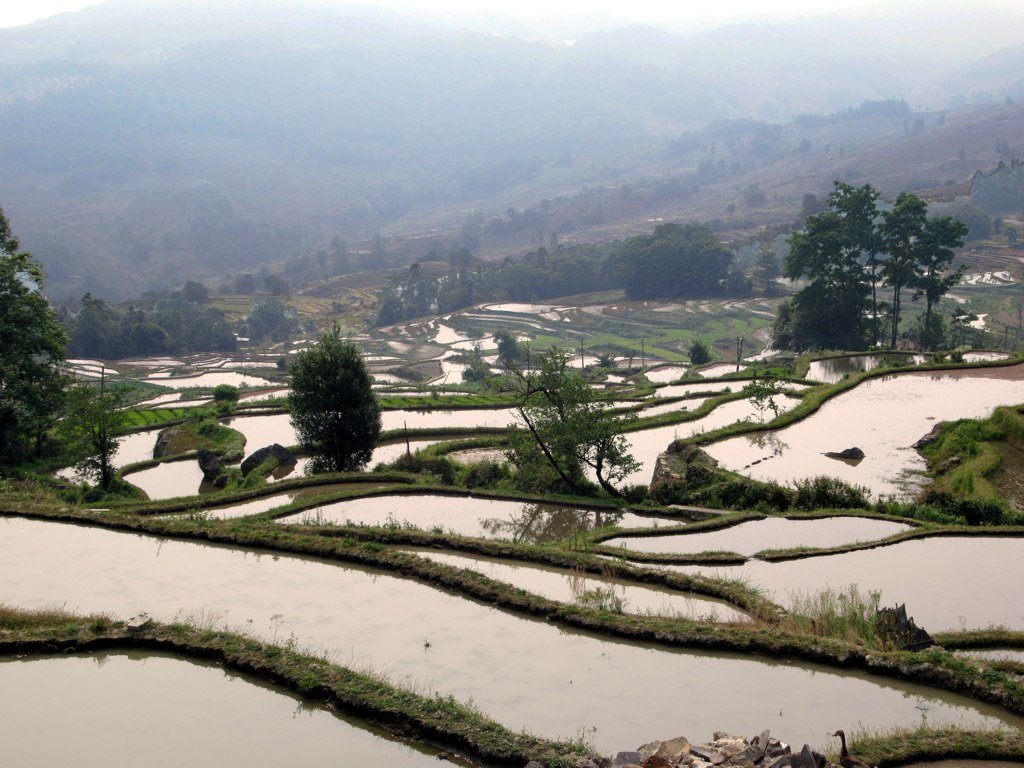
Water moves by gravity alone through four trunk canals and 392 branch ditches, a maintained network 445.83 km long (UNESCO). Forest above 2,000 metres is kept intact as a recharge zone, and channels follow the contour rather than dropping straight down, so the flow arrives without cutting the slope. At each junction a notched wooden board divides the stream: a wider notch means more water.
A ditch keeper, the gangouren, walks the channel clearing blockages and settling disputes (Xinhua, 22 March 2022). When a channel silts up, terraces below lose water within days and dry walls collapse — which is why crossing a paddy for a photograph is not a small thing.
Yuanyang or Longji: which rice terraces should you choose?
Yuanyang and Longji are the two terrace landscapes travellers most often weigh against each other, and they suit different trips. Longji sits two hours from Guilin and folds neatly into a Guangxi itinerary; Yuanyang is higher, remoter and far larger, which is why its winter mirrors are harder to match.
| Yuanyang, Yunnan | Longji, Guangxi | |
|---|---|---|
| Scale | 16,603 ha, up to 3,700 levels | Smaller, tighter basins |
| Mirror season | Late November–April | May–June, after transplanting |
| Access | Train to Jianshui, 2 h road | About 2 h bus from Guilin |
| Best for | Scale and Hani villages | Short trips, village walks |
Our piece on why the Longji rice terraces showcase agricultural genius covers the Guangxi side in detail.
How do you get to the Yuanyang rice terraces?
The Yuanyang rice terraces have no railway station and no commercial airport, so every route ends with a climb to Xinjie, the old county town at about 1,570 metres where the viewpoints begin. The comfortable version is high-speed rail from Kunming South to Jianshui, about 1 hour 45 minutes, then a pre-booked car for the two-hour ascent. Book the car before you arrive.
| Route from Kunming | Time | Cost | Who it suits |
|---|---|---|---|
| Train to Jianshui + car | 3.5–4 h | ~80 CNY train, ~400 per car | Most travellers |
| Direct coach to Xinjie | 5–6 h | ~110 CNY | Budget; 3–4 daily |
| Private car throughout | 4.5–5.5 h | ~250 CNY fuel and tolls | Groups; 300–320 km |
One warning saves an evening: Nansha is not Xinjie. Nansha is the county seat, 28–35 km below in the hot Red River valley at about 240 metres, with no terraces in sight. A hotel there turns a 06:00 sunrise into 90 minutes of dark driving, so check the address.
Should you sleep in Xinjie, Duoyishu or Nansha?
Xinjie is the practical base for most visitors: the widest choice of rooms, restaurants and heating, with Duoyishu 45 minutes away. Sleeping in Duoyishu or Shengcun instead buys an extra hour in bed and often a rooftop facing the water, at the cost of thinner food and colder rooms.
A three-day sequence that works
- Day one: arrive by mid-afternoon, buy the ticket in Xinjie, scout Bada for sunset.
- Day two: leave at 05:45 for Duoyishu, then Aichun’s blue paddies at 09:30.
- Day two, afternoon: rest or walk Azheke, and be at Bada by 17:15.
- Day three: Qingkou’s mushroom houses and water channels, then the road out.
- Keep one morning spare. Fog erases roughly a third of all dawns.
Practical tips before you go
- Buy the 70 yuan pass once: three days, unlimited entry to Duoyishu, Bada, Laohuzui and Qingkou (Yunnan Provincial Department of Culture and Tourism, 11 August 2026).
- Carry cash. Alipay works widely, but village gates sometimes cannot take a foreign card.
- Pack for 10°C mornings and 20°C afternoons; the platforms are windy.
- Stay off the flooded paddies. They are somebody’s income and the walls are mud.
- Motion sickness tablets help: the road climbs 1,300 metres in 30 km.
One clear dawn justifies the journey
Yuanyang rewards the traveller who builds in slack. A single clear dawn at Duoyishu pays for the trip; two almost guarantee it. Come in the second half of winter rather than the first, sleep above the valley rather than below it, and let the water work. If you are still shaping a Yunnan route, our notes on highland trekking on a budget and Tengchong’s ginkgo village sit well beside this one.
Frequently asked questions
When is the best time to see the Yuanyang rice terraces?
Late December to February gives the fullest mirrors, because every terrace is flooded and the air is dry. Late November starts the water season but fields fill unevenly, and by May the paddies are green rather than reflective.
How many days do you need at the Yuanyang rice terraces?
Three nights is the sensible minimum: one dawn at Duoyishu, one dusk at Bada, and a spare morning for fog. Two nights works if you accept a single sunrise, since viewpoints sit 15–25 km apart on mountain roads.
How much is the ticket, and is it valid for several days?
The scenic-area pass costs 70 yuan and covers three days of unlimited entry to Duoyishu, Bada, Laohuzui and Qingkou, as of November 2026. Azheke village charges a separate 30 yuan, and children under 1.2 metres enter free.
Can you visit the terraces without hiring a car?
Public minibuses link Xinjie with the villages, but they do not run before about 05:00 or after about 19:30, so they cannot deliver you for sunrise or collect you after sunset. A driver for the day costs roughly 200–300 yuan.
What is the altitude, and is altitude sickness a risk?
Viewpoints sit between about 1,600 and 1,900 metres, and the highest terraces reach 2,023 metres. That is well below the threshold where altitude illness usually begins, so breathlessness on stairs is normal and serious symptoms are rare.
Is the sunrise at Duoyishu worth the early start?
Yes on a clear morning, and the platform fills by 06:00 for good reason: water turns from grey to pink to gold in about four minutes. If fog closes in, stay an hour — it often lifts in a single sheet.