


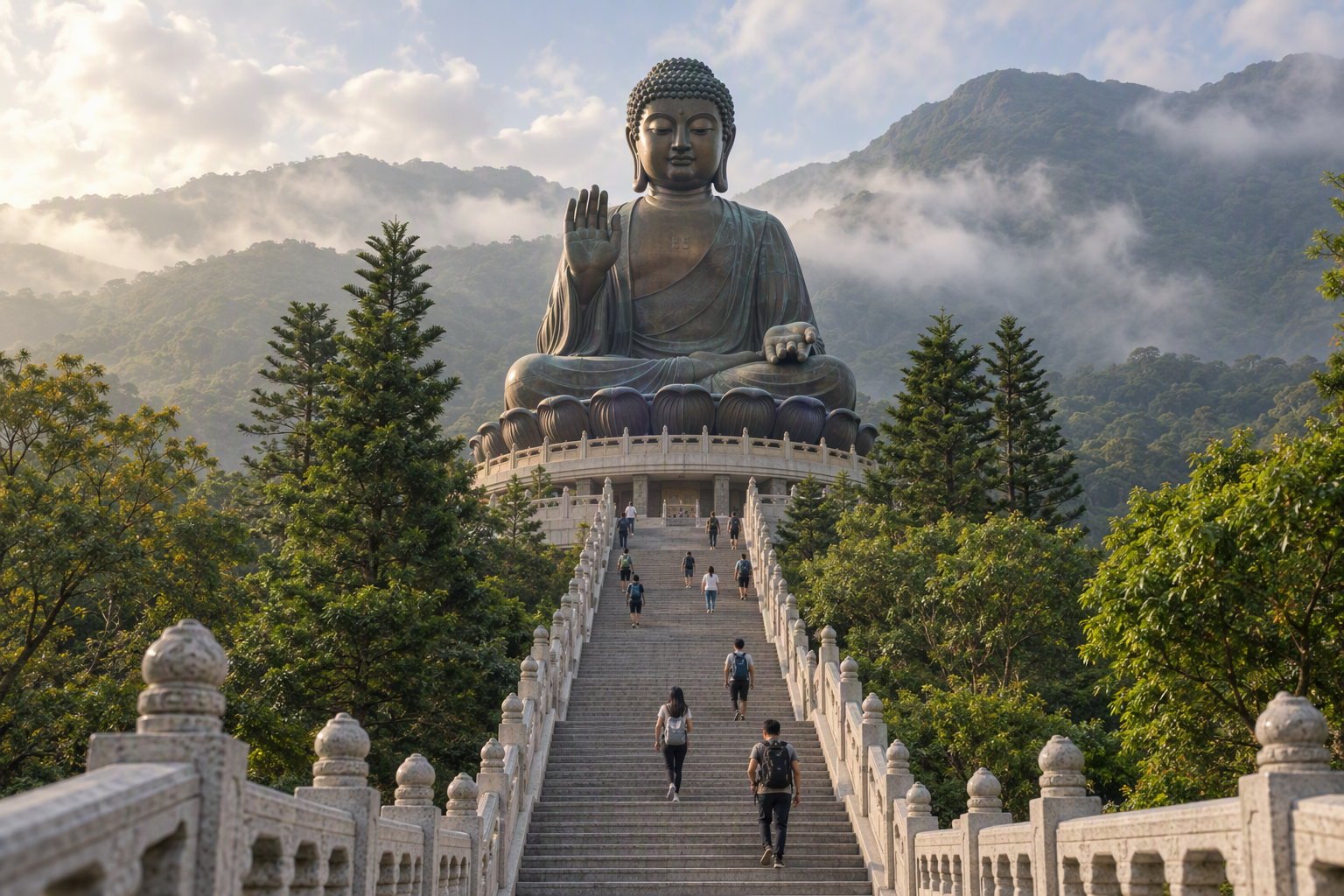
The short answer: Five days lets you run the classic three city days and then give two full days to the edges of the territory: Lantau Island with the Tian Tan Big Buddha, Po Lin Monastery and the stilt-house village of Tai O, then Sai Kung or the outlying islands for seafood and coastline. Base yourself once and stay put – moving hotels mid-trip wastes half a day.
Key takeaways
- Days 1-3: the standard city core – Hong Kong Island, Kowloon, then the harbour and a slower evening.
- Day 4: Lantau Island – Ngong Ping 360 cable car, the Big Buddha (268 steps), Po Lin Monastery, then bus 21 to Tai O.
- Day 5: Sai Kung for seafood and island hopping, or Cheung Chau and Lamma by ferry from Central.
- Mid-range five-day budget: about HK$5,500-9,500 per person excluding flights.
- Book the Ngong Ping 360 cable car online the day before; the walk-up queue at Tung Chung is Hong Kong's longest.
- Keep one hotel for the whole trip: Tsim Sha Tsui, Causeway Bay or Kennedy Town.
- Allow 45-60 minutes of travel each way to Lantau and to Sai Kung.
Five days is where Hong Kong stops being a city break and starts being a trip. You still get the Peak and the harbour, but you also get an island with no cars, a fishing village on stilts, and a coastline that looks nothing like the postcard skyline.
The key difference from a 3-day itinerary is that you can stop compressing. Days 1 to 3 stay close to the classic plan. Days 4 and 5 go out to the edges of the territory, and they are the days people talk about afterwards.
How to structure five days
The mistake is to treat days 4 and 5 as “extra” and fill them with more city. Do the opposite: give them entirely to the islands and the coast, and accept that you will spend 45 to 60 minutes getting there.
| Day | Area | Pace |
|---|---|---|
| 1 | Hong Kong Island | Busy |
| 2 | Kowloon | Busy |
| 3 | Victoria Harbour and Central | Medium |
| 4 | Lantau Island | Slow |
| 5 | Sai Kung or the Outlying Islands | Slow |
Days 1 to 3 — the classic core
Run the first three days as per the 3-day Hong Kong plan: the Peak and Central on day one, Tsim Sha Tsui and the Kowloon markets on day two, the harbour and a slower evening on day three. Do not over-plan these. They are the days when you are still learning the MTR and the food.
Finish day 3 early. You want to be rested for Lantau.
Practical tip: Buy your Ngong Ping 360 cable car ticket online on day 3, for an early slot on day 4. The walk-up queue at Tung Chung is the single longest tourist queue in Hong Kong.
Day 4 — Lantau Island
Lantau is nearly twice the size of Hong Kong Island and almost entirely empty of high-rise. The day has three parts and they chain together naturally.
Tung Chung to Ngong Ping
Take the MTR to Tung Chung, then the cable car up to Ngong Ping. The ride is about 25 minutes and the approach to the airport and the bay is genuinely spectacular. Get a crystal cabin only if you are comfortable with glass floors; otherwise the standard cabin is fine.
The Big Buddha and Po Lin Monastery
At the top you have the Tian Tan Buddha — 268 steps, free to climb — and Po Lin Monastery next door. Allow two hours. The monastery kitchen serves a vegetarian lunch that is better than the tourist-average food up there. There is more on the Big Buddha and the area here.
Tai O fishing village
Take bus 21 from Ngong Ping down to Tai O, the stilt-house fishing village on the west coast. Allow three hours. Walk the lanes, take a small boat through the stilt houses (about HK$30, negotiable), and eat the shrimp paste and the salted fish. Tai O has its own guide here.
Come back to the city via Tung Chung. It is a long day — leave by 8:30am and expect to be back by 7pm.
Practical tip: Tai O is the part most people skip and the part they regret skipping. If you only have time for one thing on Lantau, make it Tai O rather than the cable car.
Day 5 — Sai Kung, or the Outlying Islands
You have two good options and they suit different people.
Option A: Sai Kung
Sai Kung is a fishing town on the eastern side of the New Territories, and it is the best seafood in Hong Kong. Take the MTR to Choi Hung or Hang Hau and then a minibus, or a taxi directly. Total travel time is 45 to 60 minutes.
Spend the morning walking the waterfront seafood market, then take a kaido (small boat) out to one of the islands — Sharp Island and its tombolo sandbar is the classic choice. Come back for a late seafood lunch where you pick the fish from the tank.
Option B: Cheung Chau or Lamma
Cheung Chau is a small island with no cars, a market street, and a beach — good for a half-day. Lamma has hiking trails and a slower feel. Both are reached by ferry from Central, 30 to 50 minutes depending on the ferry type.
If you are travelling with children, choose Cheung Chau. If you want a walk, choose Lamma.
Practical tip: Sai Kung’s seafood restaurants are priced per 100g and the final bill can surprise you. Ask for the price of the fish before it goes to the kitchen, and confirm whether the service charge is included.
Budget for five days
Mid-range, per person, excluding flights:
| Item | Cost (HK$) |
|---|---|
| Accommodation, 4 nights | 3,600–6,400 |
| Food and drink | 1,200–2,000 |
| Transport, including cable car and ferries | 400–600 |
| Attractions and entries | 300–500 |
| Total | 5,500–9,500 |
Add roughly HK$1,000 if you want one upscale dinner. Five days in Hong Kong is comfortably a HK$6,000–10,000 trip per person, and the accommodation is always the variable.
Where to stay for five days
For a five-day trip, base yourself once and stay put. Moving hotels mid-trip wastes half a day in Hong Kong.
Tsim Sha Tsui remains the best all-round base and gives you the harbour view. Causeway Bay is better value for five nights and better connected to the east. Kennedy Town suits anyone who wants quiet and does not mind the Island line.
See the Hong Kong hotels by budget list for specific properties.
Frequently asked questions
Is 5 days too many for Hong Kong?
No. Five days lets you see the city properly and still have two full days on the islands. It is the point where the trip stops feeling rushed.
Should I do Lantau and Sai Kung on consecutive days?
It works, but both are long travel days. If you can, put a lighter city day between them. If not, at least start Lantau early and keep Sai Kung as a half-day.
Do I need a guide for the islands?
No. All the transport is public and well signposted in English. A guide adds context on Lantau but is not necessary.
What is the best month for this itinerary?
Late October to November. You get clear skies for the cable car and the harbour, and the hiking on Lamma and Sai Kung is comfortable. Avoid July to September — the boat trips get cancelled in bad weather.
Can I swap Sai Kung for Ocean Park or Disneyland?
You can, but it changes the trip from a varied one into a theme-park one. If you want Disneyland, add a sixth day rather than replacing the islands.
How much walking is involved?
Expect 12,000 to 18,000 steps on the city days and 8,000 to 12,000 on the island days. Lantau involves a lot of standing on the cable car, which is more tiring than it sounds.
Is it worth adding Macau as a day trip?
As a sixth day, yes. As a replacement for Sai Kung or Lantau, no. The ferry eats three hours of your day and Macau deserves more than a rushed afternoon.
Do I need to book ferries in advance?
No, but for Sai Kung’s kaido boats you negotiate on the pier. For the Cheung Chau and Lamma ferries, just turn up — the fast ferries run regularly.