


Furong Town: A Waterfall Village Hanging Over the River
At half past seven the lights come on along the cliff, and the sound arrives before the picture does: a steady roar behind the teahouses, close enough to feel through the flagstones. You turn a corner in the lane and there it is — water dropping out of the town itself, straight into the river below.
Furong Town is a Tujia riverside settlement in Yongshun County, Hunan, built on a cliff where a stream drops about 60 metres into the You River. The old town is known for its waterfall, its 940 AD bronze treaty pillar, and its role in a 1986 film that gave the place its modern name. High-speed trains from Zhangjiajie West take roughly 25 minutes.
At jusha.travel, we love sharing tips that turn a famous photo into a night you actually remember. Here is what the waterfall is, why the town looks the way it does, and how to see it in a day or two.
What is Furong Town, exactly?
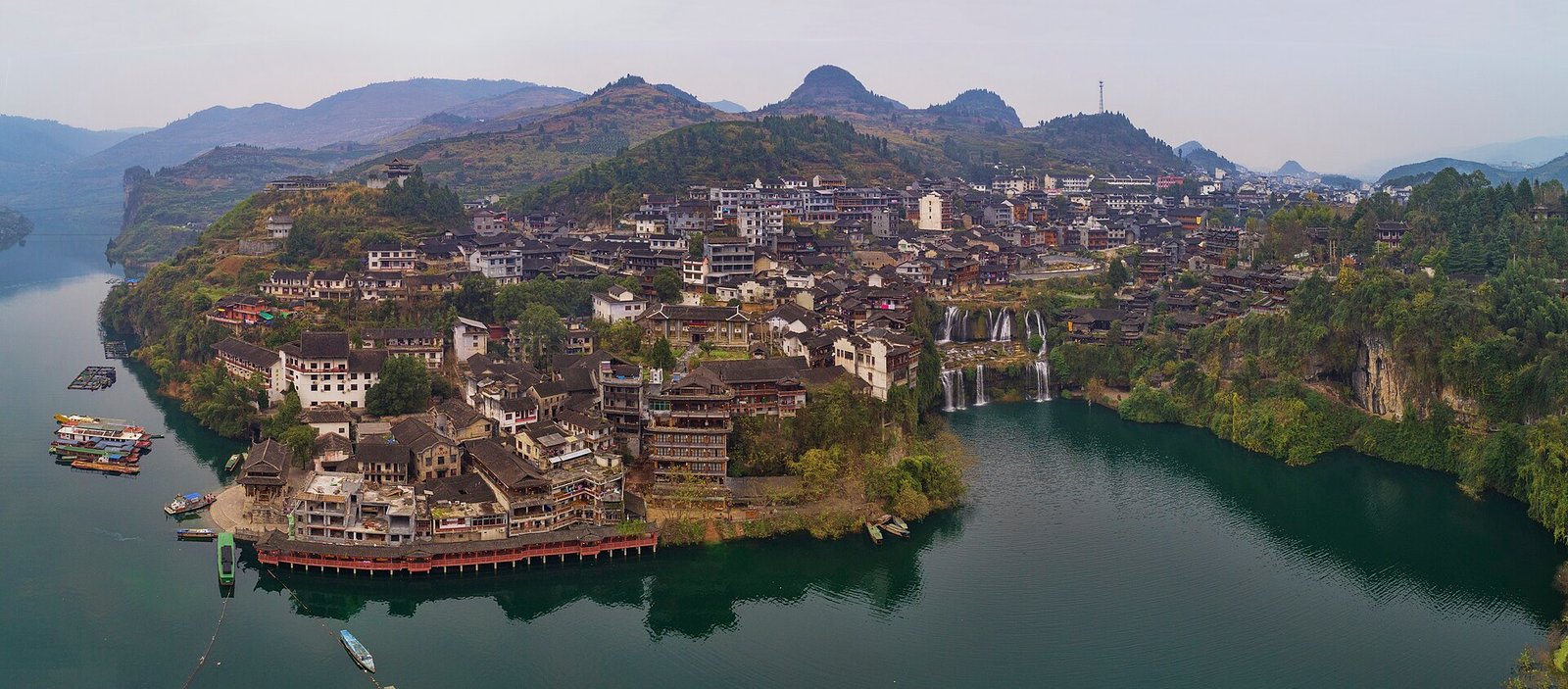
Furong Town is a 2,000-year-old settlement on the You River in western Hunan, 51 km from Yongshun’s county seat and formerly the seat of a Western Han county. It was called Wangcun for most of its history, and served as the river port where goods from Sichuan and Guizhou reached the Dongting basin.
The old town is compact: a five-li flagstone street climbing between wooden stilt houses, a row of cliff-edge teahouses, and the waterfall cutting the whole thing in two. Yongshun County Government records describe the town as one of the four great market towns of western Hunan, nicknamed “little Nanjing” for its trading wealth (Yongshun County Government).
Why the waterfall runs through the town, not past it
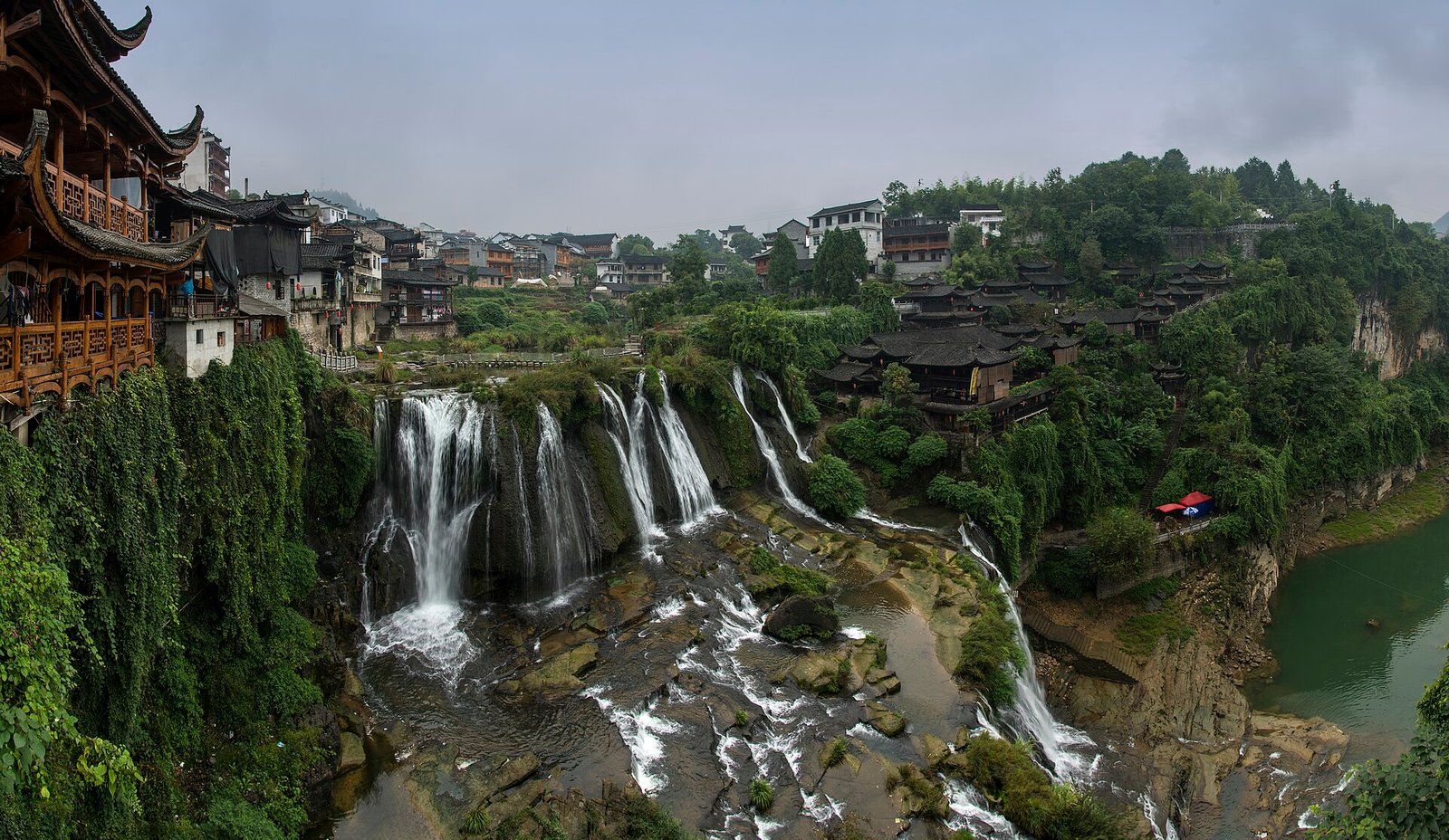
The Furong Town waterfall is a two-stage drop of roughly 60 metres over a width of about 40 metres, falling from the cliff at the end of the old street directly into the You River. What makes it unusual is the position: houses stand on both banks of the stream above the lip, so the water leaves the town rather than passing beside it.
A flagged path runs behind the falling water, cut into the rock, and it is the reason to bring a rain jacket rather than an umbrella. Spray soaks the steps even in dry weeks. Below, at the old Wangcun wharf, the view reverses: waterfall, stilt houses and river in one frame, which is the shot most photographers come for.
The waterfall sits inside the Furong park of the Xiangxi UNESCO Global Geopark, designated on 10 July 2020 across 2,710 km² and seven parks, and the same karst terraces that shape the drop expose a Cambrian boundary layer geologists travel for (Hunan Provincial Government, 21 October 2024).
The film that renamed the town
Furong Town took its present name from a 1986 film directed by Xie Jin, starring Liu Xiaoqing and Jiang Wen, which was shot on these streets and told the story of a woman selling rice tofu through two decades of political upheaval. The town was still Wangcun on the maps; the film made the other name stick.
Liu Xiaoqing’s rice tofu — mi doufu, a soft rice-flour cake served cold with chilli, soy and pickles — is now sold on every second corner, usually with a photograph of the actress above the stall. It costs about 10 CNY and is worth eating once, for the ritual rather than the flavour. Elsewhere, look for Tujia smoked pork, sour radish and san xia guo, a three-ingredient clay-pot stew.
What is left of the Tusi kingdom?
The Xizhou Bronze Pillar is the most important object in Furong Town: a 940 AD treaty recording the peace between the Chu king Ma Xifan and the local ruler Peng Shichou, cast in 5,000 jin of bronze and inscribed on eight faces. It stands today in the town’s folk-customs hall, and has been a national key cultural relic since 1961.
The pillar matters because it marks the beginning of the Tusi system, the hereditary local rule that Beijing used across south-west China from the 13th century to the early 20th. UNESCO inscribed the Tusi Sites in 2015, and the serial property includes Laosicheng, the Peng family’s headquarters elsewhere in Yongshun County (UNESCO World Heritage Centre).
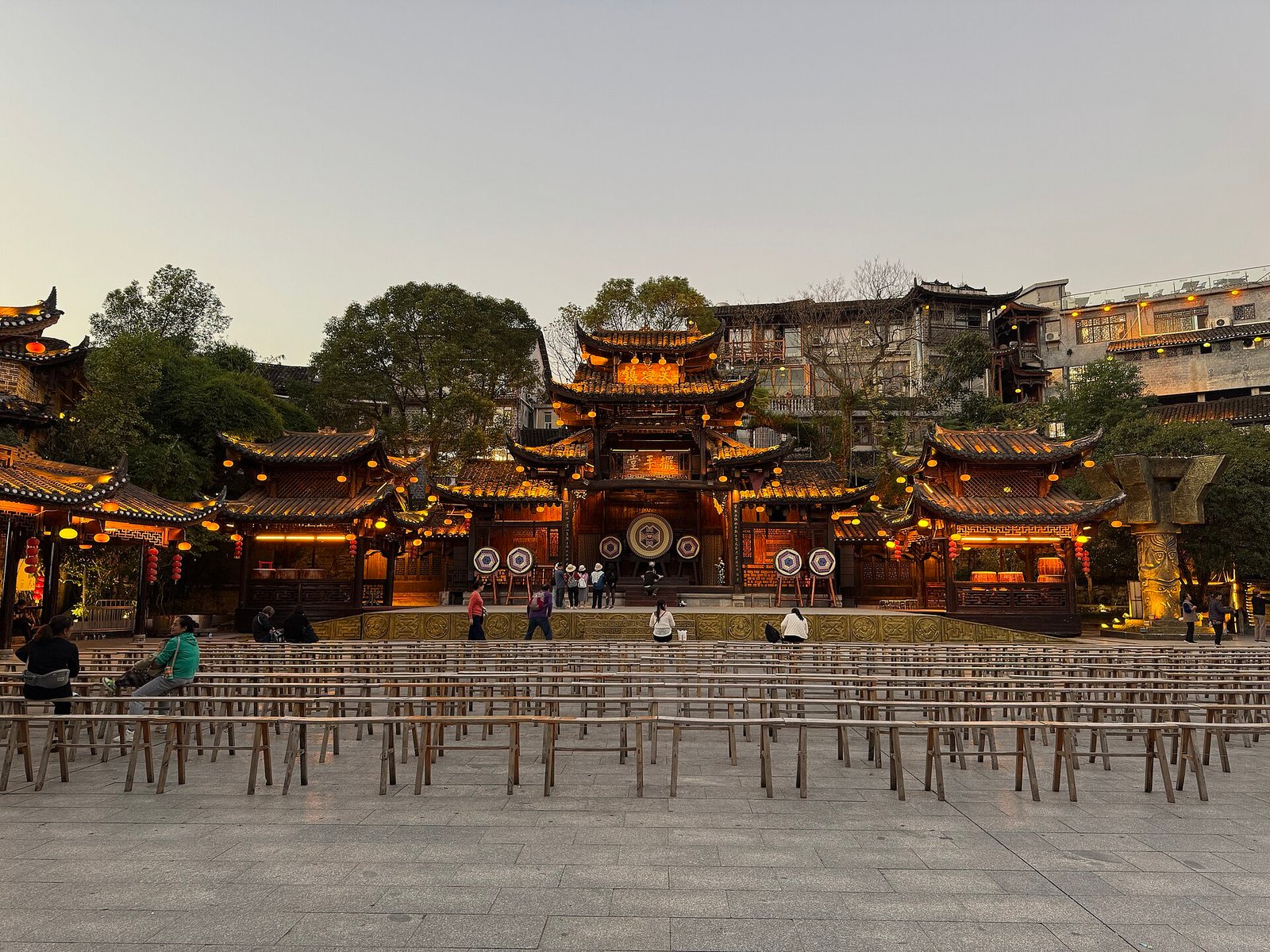
This is not a decorative old town: the cliff, the pillar and the river port are the infrastructure that made a frontier polity work. The Tujia hand-waving hall, where drum performances run in the evening, is the other place to spend twenty minutes.
When should you go?
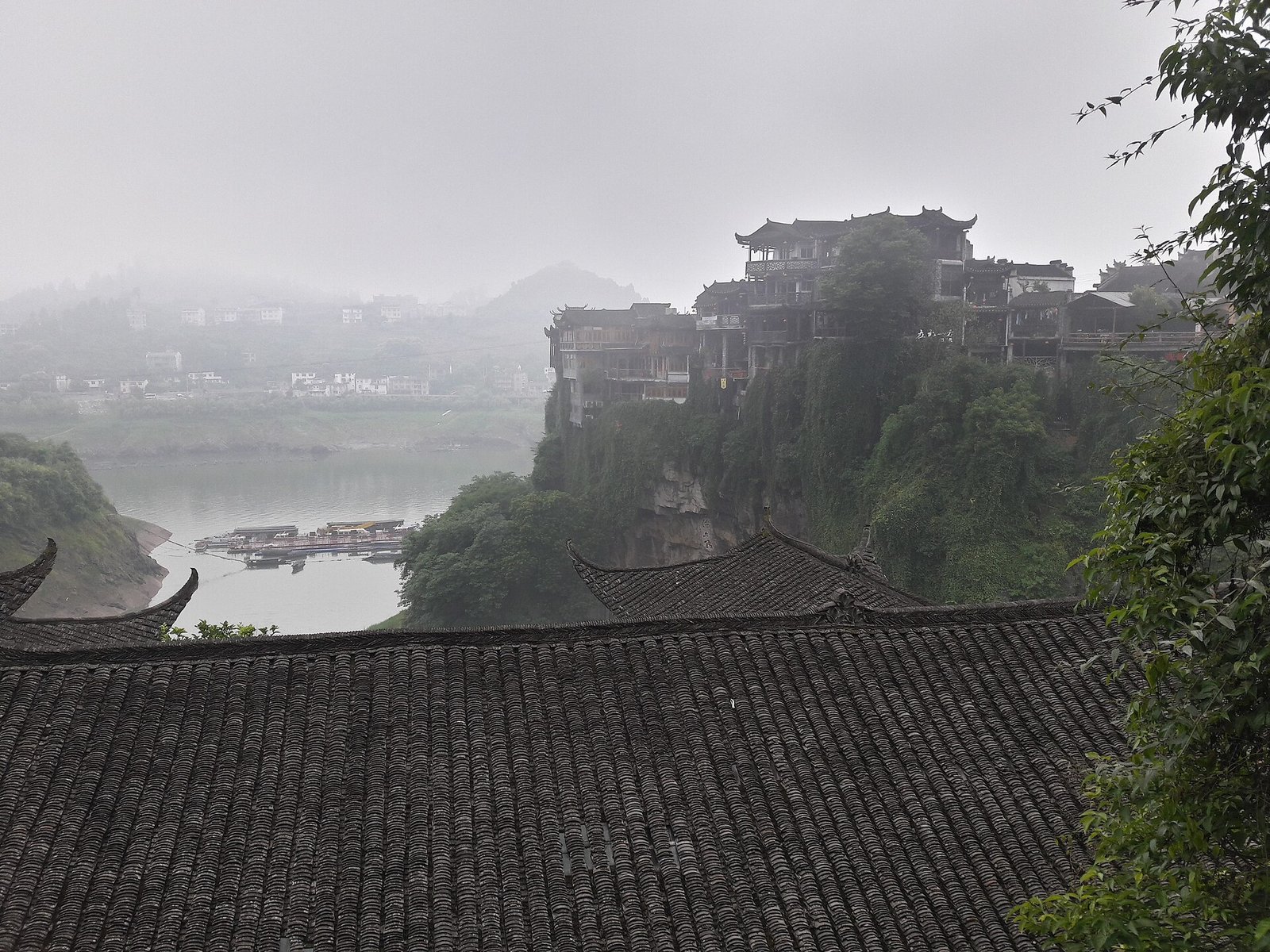
May to September gives the Furong Town waterfall its volume, because summer rain feeds the stream above the cliff; November to March gives you the town without the crowds. The trade-off is simple: full water and wet steps, or dry paths and a thinner white ribbon over the rock.
| Season | Water | Crowds | Verdict |
|---|---|---|---|
| Apr–Jun | Strong, rising | Moderate | Best balance |
| Jul–Aug | Heaviest | Very heavy | Book ahead |
| Sep–Oct | Good early, thinning | Heavy on holidays | Good light |
| Nov–Mar | Light flow | Light | Quietest, cheapest |
Rain matters more than season. A single wet week in April produces a better waterfall than a dry August, so check the forecast for Yongshun rather than the calendar. Nights are lit from about 19:30 and the gate stays open until 23:00.
How do you get to Furong Town?
Furong Town has its own station on the Zhangjiajie–Jishou–Huaihua high-speed line, which opened on 6 December 2021 with seven stations along 245 km. Zhangjiajie West to Furong Town takes about 23 minutes; Jishou East is roughly 30 minutes away; Changsha requires a change and about four hours in total.
| From | Time | Then |
|---|---|---|
| Zhangjiajie West | 23 min by rail | Shuttle or taxi to the gate, about 15 CNY |
| Jishou East | 30 min by rail | Same shuttle arrangement |
| Zhangjiajie bus station | 1.5–2 h by coach | Drops near the visitor centre |
| Fenghuang | About 2 h by road | Easy add-on to a Phoenix trip |
The rail line was built through the Wuling Mountains with 90 percent of its length on bridges and in tunnels (Zhangjiajie Municipal Government, 7 December 2021; Xinhua, 6 December 2021).
One day or two? Two routes that work
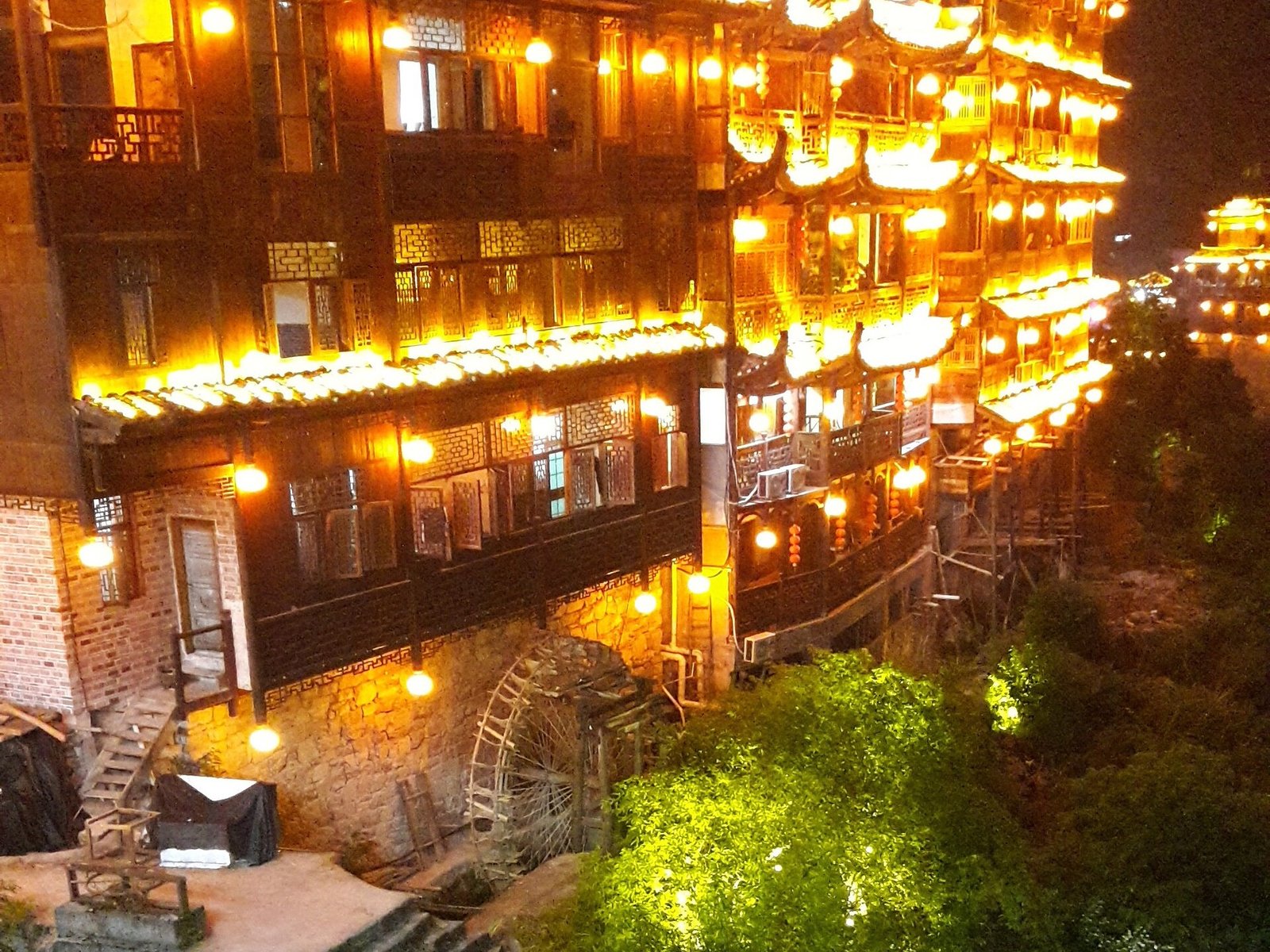
Furong Town works as a half-day stop between Zhangjiajie and Fenghuang, but the waterfall is at its best after dark, which argues for one night. The single-day version suits fixed itineraries; the overnight version is how the town is meant to be used.
- Book the 15:00 train from Zhangjiajie West so you arrive with daylight left for the old street.
- Walk the five-li flagstone street from the top gate down, past the rice-tofu stalls, to the viewing platform above the fall.
- Take the path behind the water before dark, while you can still see the rock and the steps.
- Eat early, around 18:00, at a cliff-edge restaurant where the tables face the drop.
- Wait for the 19:30 lights, then shoot from the Tu Wang Bridge and the lower wharf.
- Sleep in the old town, and walk the empty street at 07:00 before the first tour groups arrive.
Where to stay, and what it costs
Accommodation inside the old town is almost entirely converted stilt houses, and the price difference between a river view and a lane view is worth paying. Expect 300–600 CNY for a cliff-facing room in high season and 150–300 CNY in winter; the gate ticket is 108 CNY on site, 98–100 CNY online, valid for three days with unlimited re-entry.
Concessions are 64 CNY for students and visitors aged 60–64; under-14s and over-65s enter free. The ticket covers the waterfall paths, the pillar hall and the evening shows, but not the river boats. Buy online and keep the QR code — the gate scans it on every re-entry.
Practical tips for a first visit
- Pack light and wheel-free. The old town is all steps; suitcases are a genuine problem between the gate and the guesthouses.
- Bring a thin rain jacket. Umbrellas are useless on the path behind the waterfall.
- Non-slip shoes. The flagstones are polished by a thousand years of feet and stay wet near the fall.
- Arrive before 09:00 or after 20:00 if you want photographs without crowds.
Furong Town is the rare Chinese old town where the headline sight is why the settlement exists: the water chose the site, the cliff shaped the houses, the river paid for them. Give it a night rather than an afternoon, and the town stops being a photo stop. If you are building a western Hunan loop, our Zhangjiajie photography guide covers the mountains an hour north, and Fenghuang’s riverside old town is the natural next stop on the same line. For a different angle on the region’s history, read about Changsha’s Mawangdui tombs, or compare the night-time mood with Xijiang’s Miao village.
Tell us in the comments whether you went behind the waterfall — or watched from the bridge with dry shoes.
Frequently asked questions
How tall is the Furong Town waterfall?
The Furong Town waterfall drops about 60 metres in two stages and is roughly 40 metres wide. It falls from the cliff at the end of the old street directly into the You River, and a flagged path runs behind the curtain of water.
How much is the entrance ticket in 2026?
The gate ticket is 108 CNY on site and 98–100 CNY online, valid for three days with unlimited re-entry. Students and visitors aged 60–64 pay 64 CNY, while children under 14 and visitors over 65 enter free.
Can you visit Furong Town as a day trip from Zhangjiajie?
Yes. The train from Zhangjiajie West takes about 23 minutes and the shuttle from Furong Town station to the gate costs around 15 CNY. A day trip works, but you will miss the 19:30 lighting, which is the highlight.
When is the waterfall at its strongest?
July and August carry the most water, with April to June close behind and far fewer visitors. November to March is the driest and quietest period, when the fall thins to a ribbon but hotel rates drop by half.
Is Furong Town the same as Fenghuang?
No. Furong Town is in Yongshun County and is built around a waterfall and a 940 AD bronze pillar, while Fenghuang is a larger riverside town 2 hours away by road. Many travellers visit both on one loop.
What should I eat in Furong Town?
Start with Liu Xiaoqing rice tofu, the cold rice-flour cake made famous by the 1986 film, at about 10 CNY a bowl. Then try Tujia smoked pork, sour radish and san xia guo, a three-ingredient clay-pot stew served in most cliff-side restaurants.