


Xiapu’s Mudflats: Chasing China’s Most Photographed Tides
At 5:40 on a clear November morning, the bay at Beizhi is a sheet of wet pewter. Ten minutes later the sky turns the colour of weak tea, and a thousand bamboo poles rise out of water that was open sea an hour ago. Nobody speaks. Forty tripods click at once.
Xiapu is a coastal county in Ningde, Fujian Province, and its tidal flats are the most photographed in China. Xiapu mudflats photography runs on a single rule: the tide decides the picture, not the photographer. Arrive at the wrong hour and you shoot grey water; arrive at the right one and the receding sea hands you tiger-striped silt, branching creeks and the black lattice of laver nets. Trains from Fuzhou reach Xiapu station in under an hour.
At jusha.travel, we love sharing tips that turn a good trip into a memorable one, and few coasts reward preparation like this one. Below you’ll find the tide logic, the viewpoints worth a 4:30 am alarm, ticket costs and the shuttle route.
Where are the Xiapu mudflats?
Xiapu County is a coastal county of roughly 530,000 people in Ningde, Fujian Province, facing the East China Sea across from Taiwan. It holds about 1,590 square kilometres of land, some 28,900 square kilometres of sea and 442 islands, and its intertidal zone alone covers about 696 square kilometres, one of the largest in southeast China (World Bank port assessment; China Daily, 19 September 2025).
That intertidal zone is not a nature reserve. It is a working farm of bamboo poles, laver nets, oyster racks and kelp lines, tended by families who have read these tides for generations. The county now counts 71 photography viewpoints and four marked routes, and hosts an international contest that has run for ten editions (China News Service, 12 June 2026).
Why does the tide decide every photograph?
Xiapu’s flats sit in a strong-tide bay where the water moves more than five metres between high and low on an average tide, on a regular semi-diurnal cycle of 12 hours 24 minutes (Lin Hang, Journal of Fisheries Research, 2014). Two highs and two lows a day mean the schedule slides 40 to 50 minutes later each day, so yesterday’s perfect dawn is today’s flat grey sea.
Spring tides, the three days around each new and full moon, expose the widest silt and cut the sharpest patterns. Neap tides leave more water and softer reflections. Half-tide is the sweet spot for most classic frames, because water is still threading the channels while the texture shows. Whatever you plan, arrive 45 to 60 minutes early; the platforms at Beizhi and Dongbi fill fast in the golden weeks. For a very different tidal spectacle, see our post on Haining’s Qiantang River tide.
| Tide stage | What appears | Shoot it for |
|---|---|---|
| Low, ±1 hour | Bare silt, tiger stripes, branching creeks, workers on foot | Texture, abstracts, drone patterns |
| Mid, rising | Water threading the channels, poles doubled in reflection | The classic ink-painting frame |
| High | Open water, pole tops, buoys, passing boats | Minimalism, silhouettes, long lens |
When is the best time for Xiapu mudflats photography?
November is the best month for Xiapu mudflats photography, because laver nets go up between October and December, the typhoon season has ended and the sun sits low enough to rake the silt all day (China Daily, 19 September 2025). Mornings are cool and clear, and useful light lasts until about 08:30.
| Season | What’s happening on the flats | Trade-off |
|---|---|---|
| Apr–Jun | Kelp harvest; racks of dark green hanging to dry | Rich human scenes, wet weather |
| Jul–Aug | Beach season; few nets, strong haze | Heat, typhoons, closures |
| Sep–Oct | Nets go up; clear skies return | National Day crowds, 1–7 October |
| Nov–Dec | Laver nets at full spread; low, warm light | Cold 5 am starts — the best window |
| Jan–Mar | Harvest tails off; empty platforms | Flat light, fewer boats |
Book by the lunar calendar, not the weekend: spring tides land on different dates each month.
Beizhi: sunrise over the tiger stripes
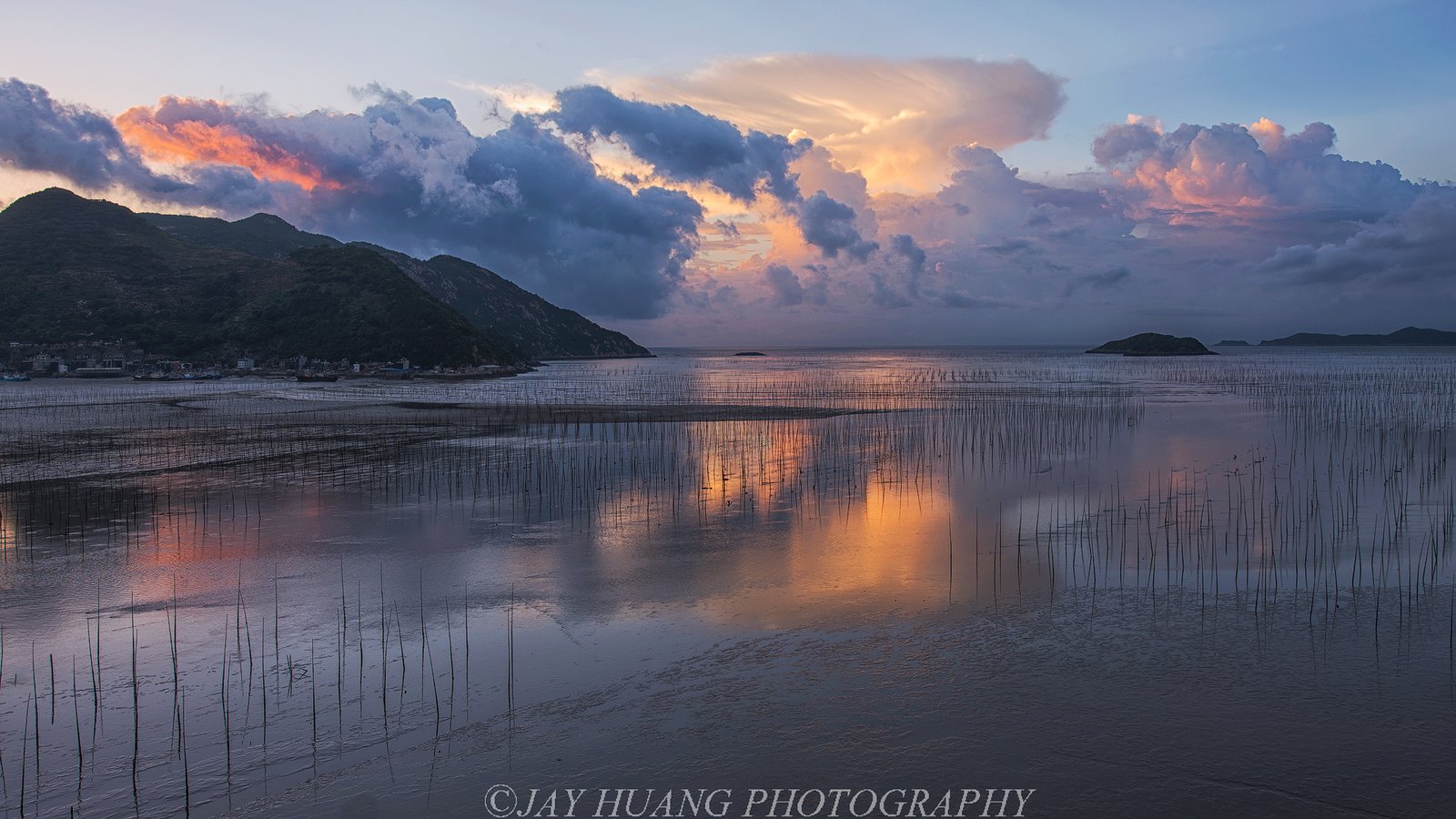
Beizhi is a fishing village about five kilometres from the county seat and the sunrise shot that made Xiapu famous. The platform above the bay is free, 15 minutes by taxi from town, and looks over a forest of aquaculture poles (as of November 2026).
Sunrise in early November falls around 6:20. The show begins in indigo, moves through pink and ends in gold on the water. The tide has to cooperate: at low water you get stripes and creek patterns, at high water you get pole reflections and passing boats. Stay until 08:30, when the falling tide exposes the full pattern below the railing.
Xiaohao: the coloured flats
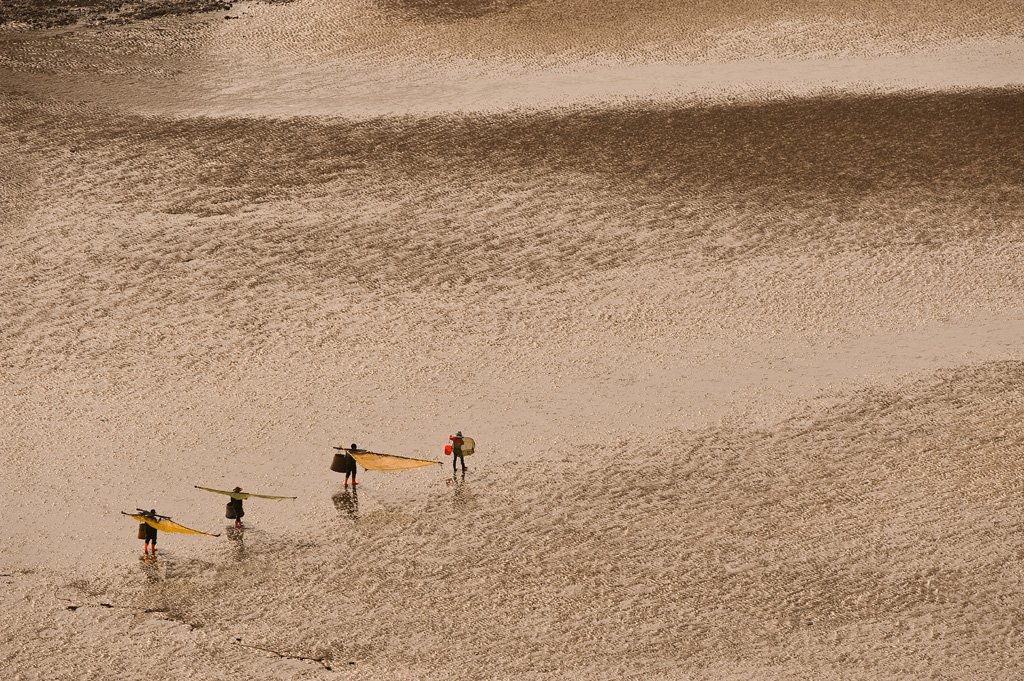
Xiaohao is a broad beach about 25 kilometres northeast of the county seat, known for purple-red rock, golden tidal channels and farmers working nets below the road. It is free and works at both ends of the day, the best fallback when the tide spoils a sunrise plan.
The classic frame looks down from the eastern headland: colour bands in the sand, water in the channels, figures bent over nets. Bring a long lens.
Dongbi: the last light
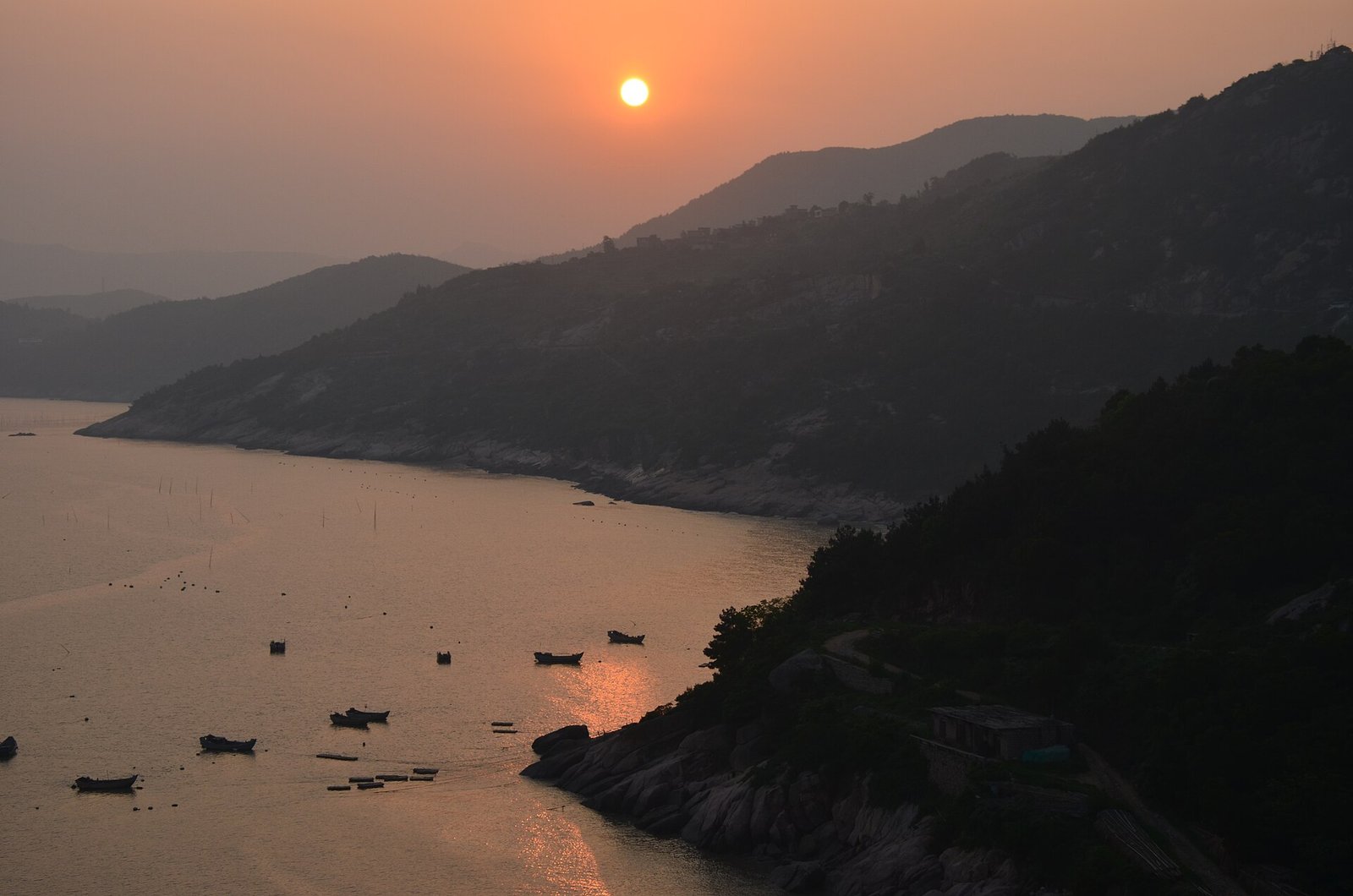
Dongbi is a clifftop village about 30 kilometres from town and the county’s sunset stage, with a boardwalk running along the cliff above the bay. Entry is free, and in early November the sun drops behind the headlands around 17:20.
Arrive an hour early and walk the light-and-shadow boardwalk before settling above the boats. On a clear evening the water turns copper, boats cut dark lines across it, and the lights of Sansha come on behind you.
Shajiang S-bend and Yangjiaxi: the inland detour
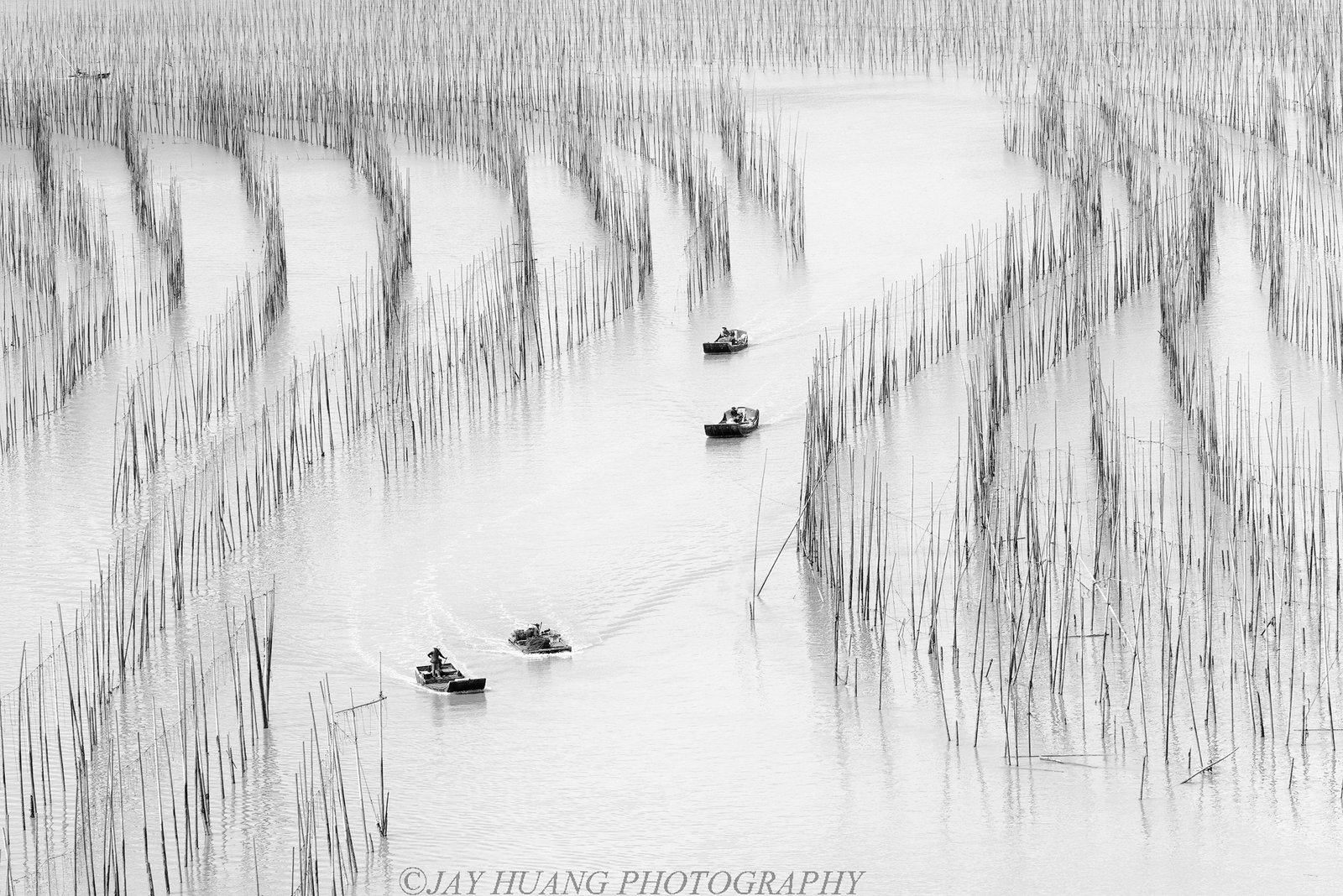
Shajiang is a fishing town about 25 kilometres southwest of the county seat, where bamboo poles are planted along an S-shaped channel and boats slide through the curve. A rooftop platform above the village charges 20 CNY and is the only way to get the aerial angle without a drone (checked November 2026).
Forty minutes inland, Yangjiaxi is the counterweight to all that salt: a grove of 17 banyans said to be more than 800 years old, mist in the branches, and light in visible shafts between 07:00 and 09:00. The grove charges about 20 CNY; the wider scenic area sells tickets from 50 to 100 CNY with rafting or glass-bridge add-ons (platform listings, November 2026). For a longer inland day, our guide to the Fujian Tulou earth castles makes a natural extension.
How do you get to Xiapu, and how do you move between viewpoints?
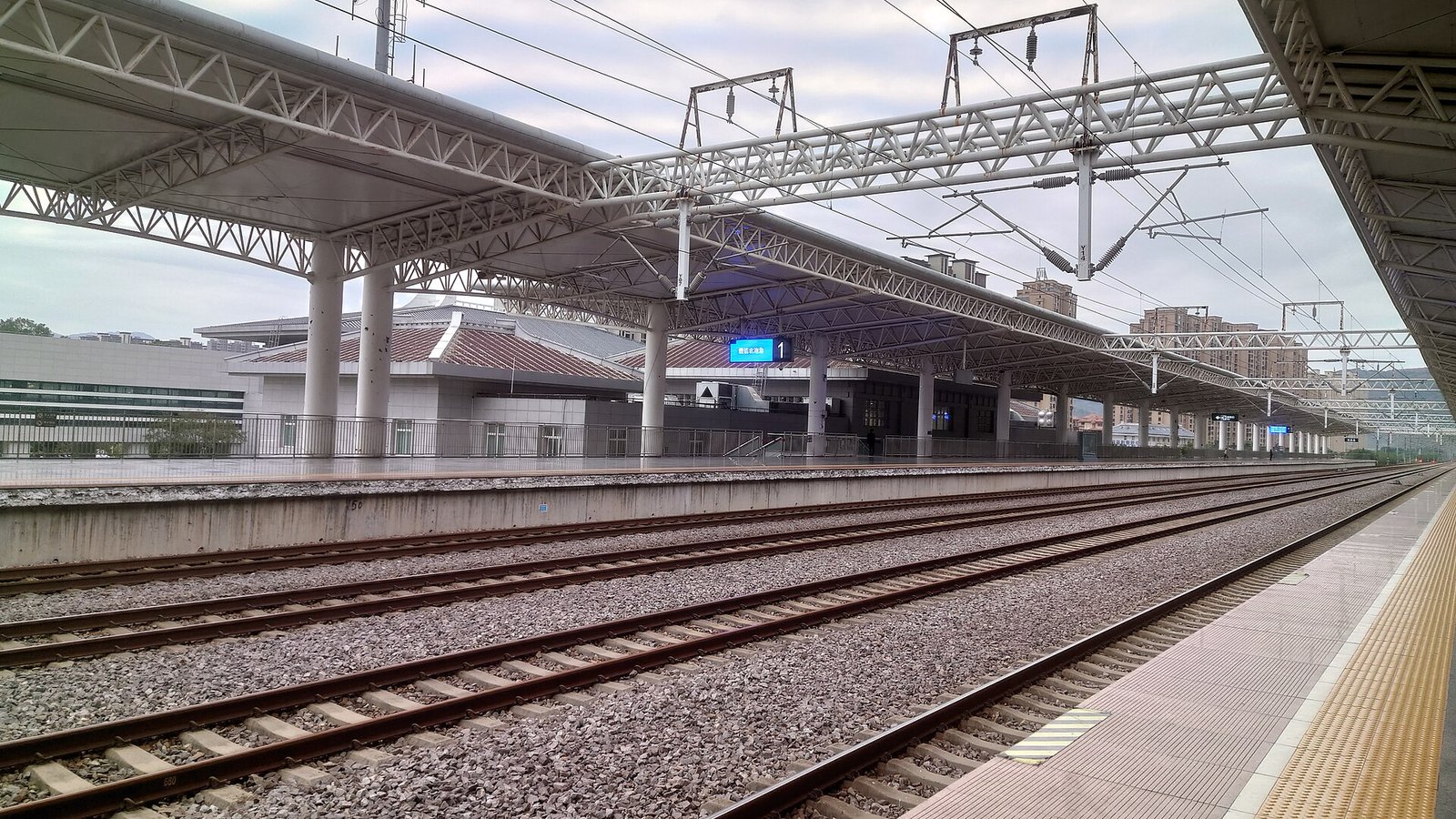
Xiapu station opened on the Wenzhou–Fuzhou coastal railway on 28 September 2009, and today puts Fuzhou about 40 to 60 minutes away, Wenzhou about an hour and Xiamen roughly two (China News Service, 28 September 2009; current timetables).
From the station, the Light and Shadow No. 1 shuttle, launched on 8 February 2026, links the county seat with Longtou, Xiaohao, the boardwalk, Yugongting, Dongbi and Sansha’s old dock. It runs 08:00–18:30 every 30 to 60 minutes for a flat 18 CNY on the seven-seat vans or 15 CNY on the larger coaches (Xiapu News, 9 February 2026).
- Book a train to Xiapu station, not Ningde — the county stop is the closer gateway.
- Check a tide table before you book dates, and pick a week when low water falls near dawn or dusk.
- Use the shuttle for midday moves; it does not run before 08:00.
- For sunrise, hire a driver the night before, at 400 to 600 CNY a day, or sleep in Dongbi or Sansha.
- Base yourself in the county seat for food and choice, or in Dongbi for a sunset balcony.
Practical tips for a first mudflat shoot
Three nights is right: six tides, one weather backup, no panic when the first dawn is flat.
- Pack a 70–200 mm lens. The flats are a compression game.
- Bring a polariser; wet silt throws glare.
- Wear shoes with grip. Platforms are slick at dawn.
- Never walk out onto the flats alone; the flood tide is fast.
- Carry small cash for platform fees.
- Keep the last morning free for a repeat visit.
Final thoughts
Xiapu rewards the traveller who plans around water rather than around sights. Pick your dates by the moon, sleep near the viewpoint you care about, and give each platform an hour instead of ten minutes. The photographs take care of themselves.
If you are shaping a longer Fujian route, pair the coast with the interior: our guide to Fujian tea tasting explains the oolong country behind these hills, and Gulangyu Island in Xiamen is the easiest add-on by rail. For the food side, start with Fujian oyster pancakes in Quanzhou.
Have you photographed these tides? Tell us which platform gave the best light, and how early you got up.
Frequently asked questions
What are the Xiapu mudflats and where are they?
The Xiapu mudflats are a 696 square kilometre intertidal zone in Xiapu County, Ningde, on Fujian’s northeast coast, about an hour by train from Fuzhou. They are working aquaculture flats of bamboo poles, laver nets and kelp lines, and they hold 71 marked photography viewpoints.
What is the best month for Xiapu mudflats photography?
November is the strongest month, with laver nets spread across the flats, clear skies after the typhoon season and low golden light from sunrise to about 08:30. October and December are close behind, and April to June brings the kelp harvest instead.
Do I need tickets for the Xiapu viewpoints?
Most viewpoints are free, including Beizhi, Xiaohao, Dongbi and Huazhu. The rooftop platform at Shajiang S-bend charges about 20 CNY, and Yangjiaxi charges roughly 20 CNY for the banyan grove or 50 to 100 CNY for the wider scenic area.
How do I get to Xiapu from Fuzhou or Xiamen?
Take a high-speed train to Xiapu station on the Wenzhou–Fuzhou coastal line: Fuzhou is 40 to 60 minutes away and Xiamen roughly two hours. From the station, the Light and Shadow No. 1 shuttle reaches Xiaohao, Dongbi and Sansha for 15 to 18 CNY.
Can I photograph the mudflats without hiring a car?
Yes, but only between 08:00 and 18:30, when the shuttle runs every 30 to 60 minutes. Sunrise and sunset shoots need a private driver at 400 to 600 CNY a day, or a guesthouse within walking distance of Beizhi, Xiaohao or Dongbi.
Is Xiapu worth visiting if I am not a photographer?
Yes. The flats are a working landscape of fishing villages, seafood stalls and cliff walks, and the shuttle makes the coast easy without a camera. Non-photographers should still check tide times, because low water is when the landscape shows itself.