


Ejina’s Golden Poplars: China’s Brief Autumn Window
By the second week of October the nights have turned cold and the first gold shows at the top of the canopy. Two mornings later the whole stand is lit from inside, and for a fortnight the Ejina poplar forest looks like a fire that has learned to stand still.
The forest lies at Dalaihubu, seat of Ejin Banner in Alxa League, Inner Mongolia, with sand on three sides, the Ejine River on the fourth and 5,636 hectares of Euphrates poplar between (China Daily, 9 December 2024). Every autumn the trees turn, the town fills, and every bed within 40 km is spoken for.
At jusha.travel, we love sharing tips that turn a famous view into a trip that works: when the gold really peaks as of October 2026, how tickets and shuttles fit together, why rooms vanish, and what a realistic two-day route looks like.
What is the Ejina poplar forest?
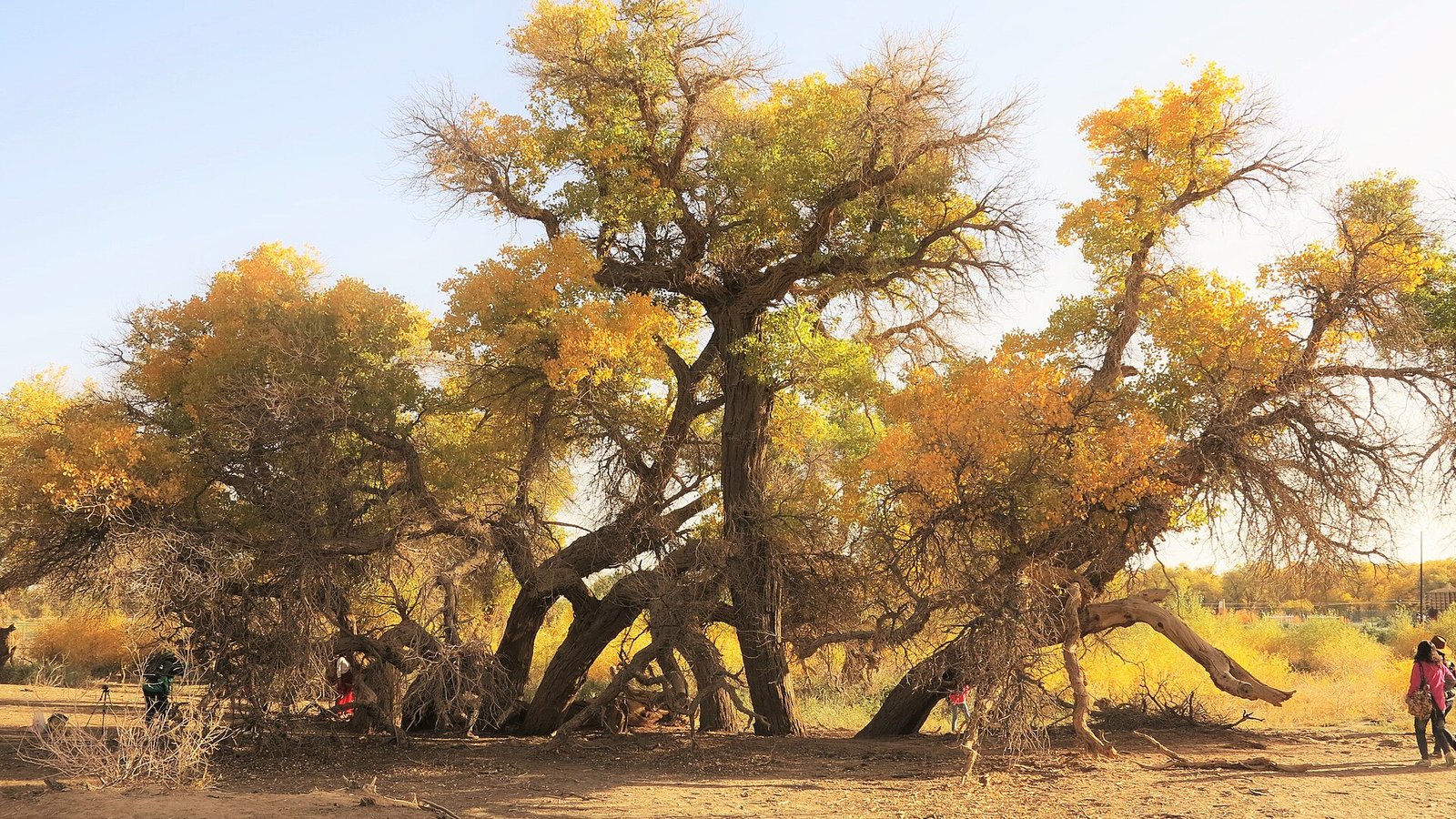
The Ejina poplar forest is a 5,636-hectare protected stand of Euphrates poplar along the Ejine River at Dalaihubu, in Ejin Banner, Alxa League, Inner Mongolia, and it anchors a national 5A-level scenic area. The species, Populus euphratica, reaches about 15 metres where groundwater stays close (Wikipedia, accessed October 2026).
Euphrates poplars are the only broadleaf trees that build real forests in these deserts. Wide shallow roots hold the sand, brackish water does not trouble them, and they line channels that would otherwise be bare gravel. Herders still run goats and Bactrian camels between the trunks, and the system drains into Juyan Lake 45 km north.
The dunes beyond the trees star in our guide to desert adventures from the Gobi to the Taklamakan.
What is the best time to see the Ejina poplar forest?
The best time to see the Ejina poplar forest in 2026 is roughly 5 to 20 October, when most of the canopy has turned and the National Day crowds have gone, though the peak can shift two weeks either way.
China Daily gives late September to mid-October as the classic range, best around 5 October (9 December 2024). The 2026 season ran later, with the 27th Ejina Golden Autumn Poplar festival opening on 2 October (Inner Mongolia Culture and Tourism Department, 4 September 2026), and China Railway kept its overnight poplar train until 16 October because demand was still climbing (CCTV News, October 2026).
| Stage | Typical window | What you see |
|---|---|---|
| First colour | 25 September – 4 October | Patchy green and gold, festival crowds, peak prices |
| Peak gold | 5 – 18 October | About 80% yellow (China Youth, 10 October 2024) |
| Late gold | 19 – 26 October | Thinning canopy, leaf carpet, thinner crowds |
| After the first gale | Late October | Black branches, best Ghost Forest silhouettes |
Why does the Ejina poplar forest turn gold for only two weeks?

The Ejina poplar forest turns gold for only about two weeks because shortening days and freezing nights break down chlorophyll quickly in very dry desert air, and often the first strong wind front then strips the canopy within days in late October.
Colour is not a slow paint job. As daylight shortens, the tree stops rebuilding chlorophyll and yellow carotenoids already in the leaf show through. In a damp climate that fade takes a month; in the Gobi, where afternoons reach 20°C and dawns hit zero, it runs at double speed. Wind finishes the job, because dried leaves release easily, and a two-day gale around 20 October can leave black branches over a yellow floor.
How do you get to Ejina?
Ejina is reached by plane to Ejina Banner Taolai Airport, by the overnight K7911 train from Hohhot, or by a five to seven-hour drive from Yinchuan or Jiuquan, and most visitors then hire a car in Dalaihubu because the sights sit 18 to 45 km apart.
Taolai (EJN) opened on 17 December 2013 as a 3C field 10 km from town, built for 50-seat turboprops rather than jets (Wikipedia, accessed October 2026), so autumn seats vanish weeks ahead. The train is steadier: K7911 leaves Hohhot at 16:53 and arrives at 08:57, with hard seats around ¥139 (China Railway timetable, 26 October 2026).
Which bridges in the Ejina poplar forest are worth your time?
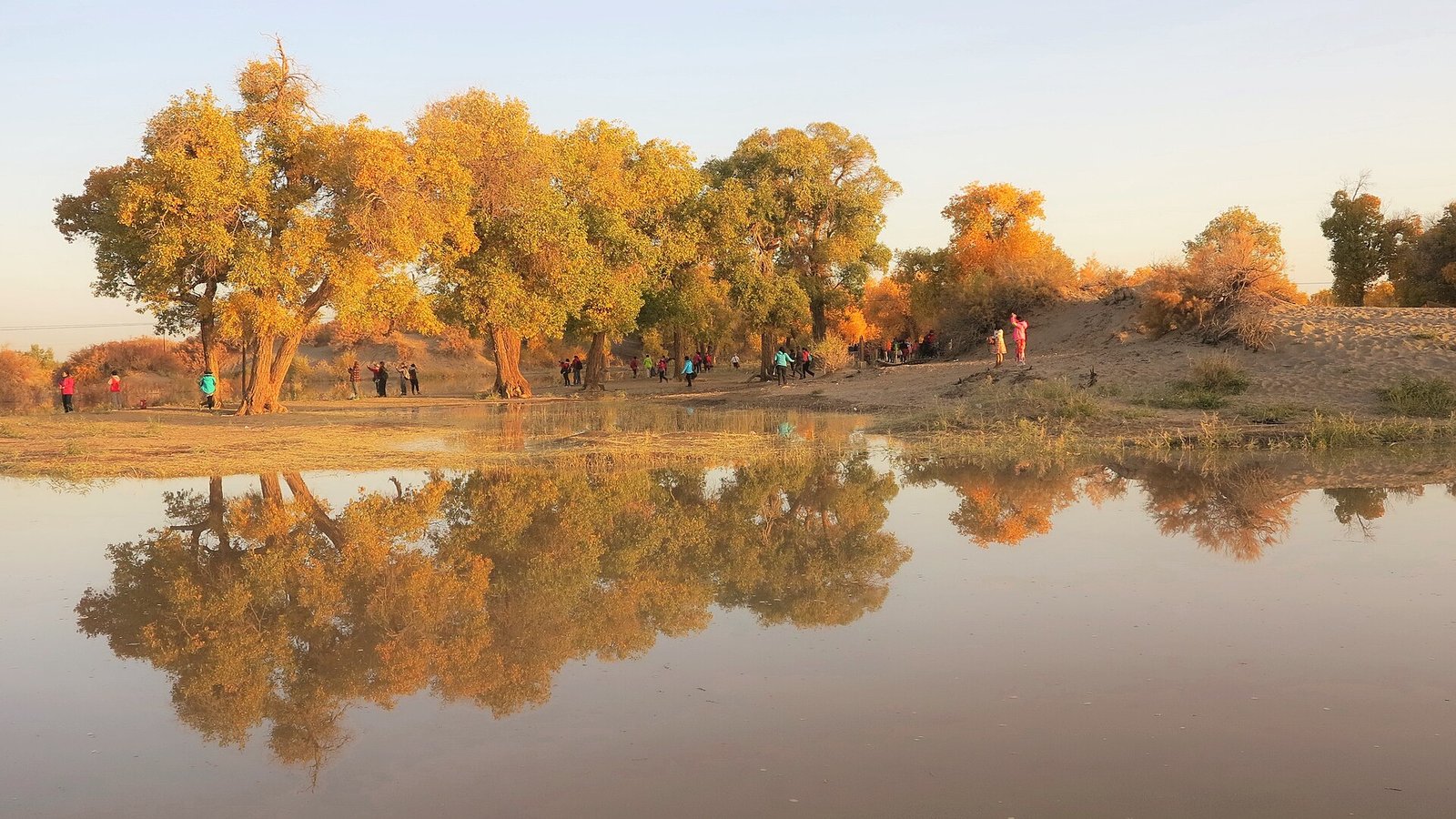
Bridges 2, 4, 7 and 8 are the four stops in the Ejina poplar forest worth building a day around, because each holds a different highlight: the reflective water, the oldest trunks, the brightest young gold and the dune edge.
Eight numbered stops are linked by shuttle over a 45 km round trip, the bus costs ¥40, and Bridges 5 and 6 remain undeveloped (China Daily, 9 December 2024).
- Bridge 2 – reflection forest, still water, best 06:30 to 08:00.
- Bridge 4 – Hero Forest, the oldest trunks, used in Zhang Yimou’s film Hero.
- Bridge 7 – Dream Forest, young dense trees that turn first.
- Bridge 8 – Badain Jaran dune edge, sunset and camel trains.
What is the Ghost Forest, and why go at sunset?
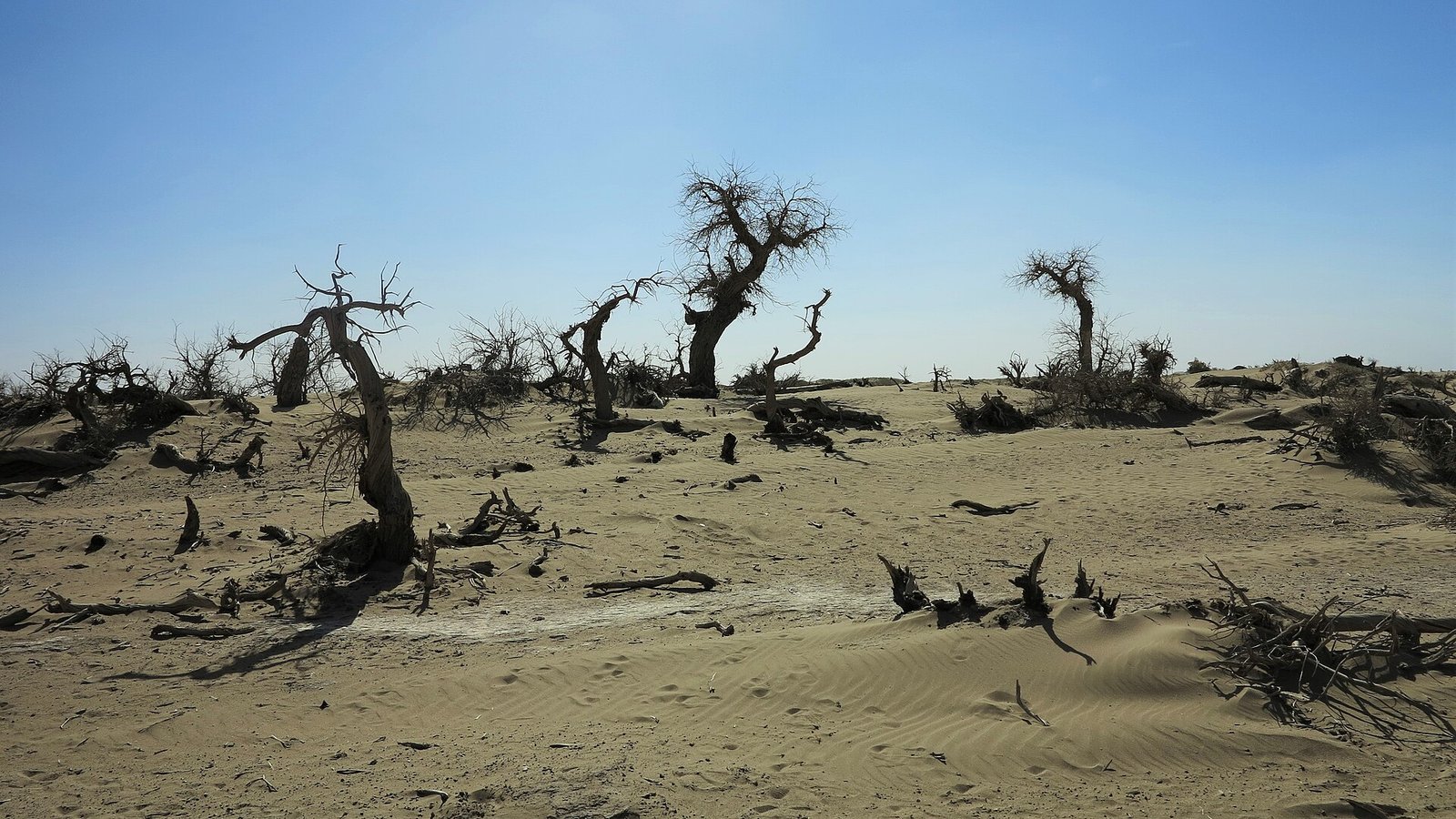
The Ghost Forest is a field of dead Euphrates poplars standing in sand about 18 km west of Dalaihubu, killed when the river channel shifted, and it is at its best in the last hour of light before the sun drops behind the dunes.
These trees died of thirst, not disease. What remains is bleached, twisted wood half-buried in dunes. Arrive by 16:30 and shoot into the sun as it drops.
Most tickets pair it with Khara Khoto, the Tangut city founded in 1032 and abandoned after a siege in 1372 (Wikipedia, accessed October 2026). The ruins take 90 minutes and the dead forest three hours.
How do you plan two days in Ejina?
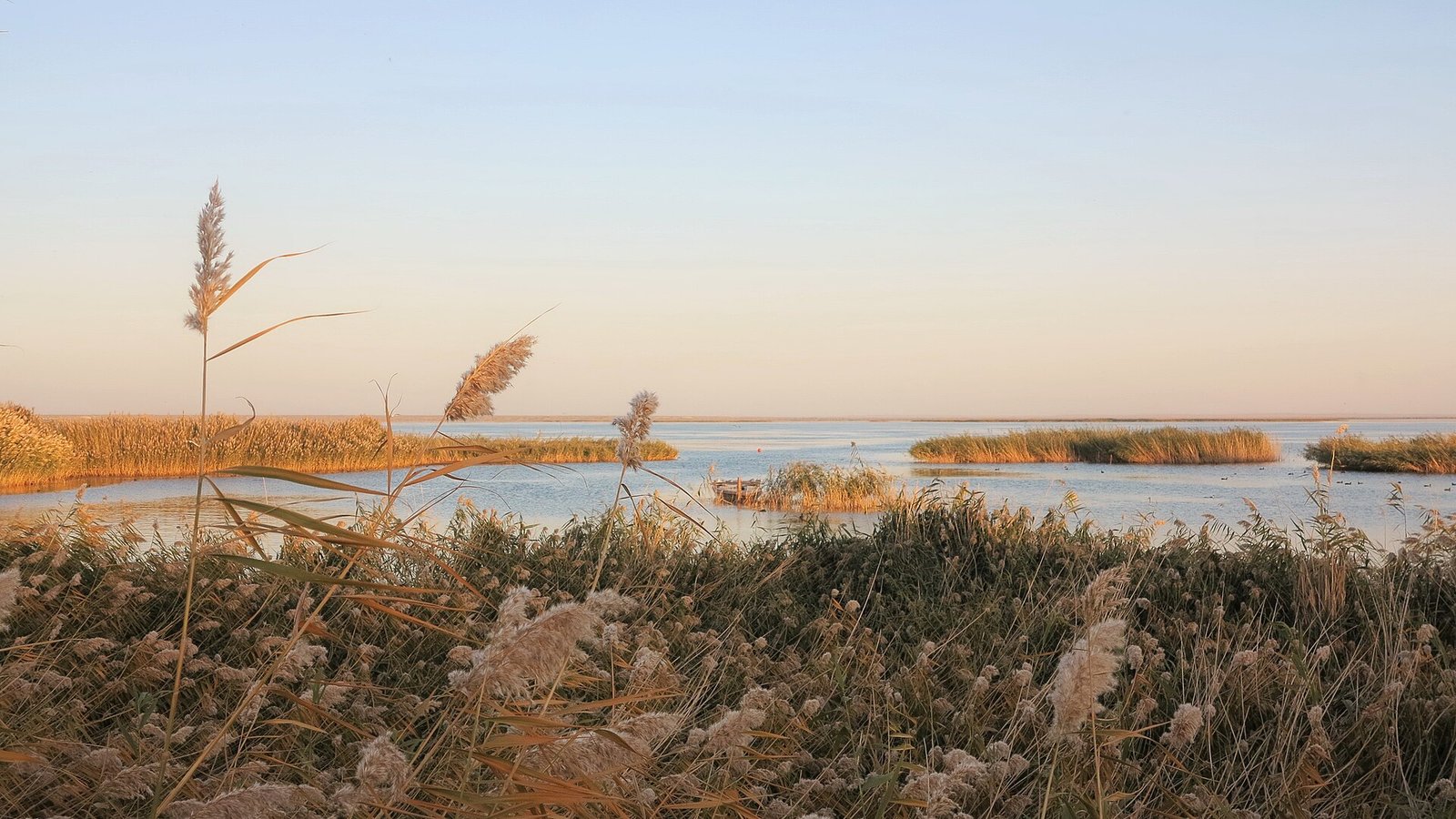
A two-day Ejina itinerary works best as sunrise at the reflection forest and sunset at Bridge 8 on day one, then Juyan Lake at dawn and the Ghost Forest at dusk on the second day, with the middle hours left for sleep.
- Sleep in Dalaihubu, ten minutes from the gate, and buy the timed ticket the day before.
- Enter at 06:00, go straight to Bridge 2 for the reflections.
- Shuttle to Bridge 4 around 10:30, then Bridge 7 in flat midday light.
- Reach Bridge 8 by 16:30 and stay for the dune sunset.
- Day two: leave at 05:00 for Juyan Lake, 45 km north, then rest at noon before Khara Khoto at 15:30 and the Ghost Forest from 17:00.
| Ticket | Price | Covers |
|---|---|---|
| Bridges 1–7 | ¥150 | Core forest |
| Bridge 8 | ¥50 | Dune edge |
| Shuttle | ¥40 | 45 km round trip |
| Juyan Lake | ¥60 – ¥75 | Wetland and sunrise platforms |
| Khara Khoto and Ghost Forest | ¥120 – ¥150 | Ruins and dead forest, plus ¥30 shuttle |
Those figures follow China Daily’s split, confirmed by the Alxa League 12345 hotline reply of 10 October 2026.
Where should you stay, and what should you book first?
Dalaihubu is where you should stay when visiting Ejina, because the town sits about 1 km from the scenic gate and every driver, guesthouse and breakfast stall works from there, which matters when you leave at 05:30 in the dark.
Ejina station handles eight to ten times its normal passenger load during the festival (CCTV News, October 2026), and nearly all of those people want a bed in the same six streets. Book four to eight weeks ahead, stay within 3 km of Bridge 1, and confirm heating and 24-hour hot water.
Practical tips for the Ejina poplar forest
Practical preparation comes down to warm layers, a booked bed and a hired driver, because the temperature swings 20 degrees between afternoon and dawn and the stops inside the Ejina poplar forest are too far apart to walk in one day.
- Tickets: reserve Ejina poplar forest entry the day before and carry the passport you booked with.
- Layers: a T-shirt at 14:00, a down jacket at 06:00, gloves for the sunrise wait.
- Dust: buff, sunglasses and a lens cloth; the wind arrives without warning.
- Cash: drivers and camel handlers prefer it, and signal is patchy.
If you would rather sleep outside town, our Inner Mongolia camping guide covers gear and water; our Shapotou desert guide is the next stop in Ningxia.
Plan for the window, not the date
This forest rewards travellers who hold a flexible five-day window in mid-October rather than a single date, because the gold can arrive a week early or leave three days after a gale, and no long-range forecast for the Gobi is reliable.
Book the bed and the train first, leave the Ejina poplar forest ticket until you land, and follow the daily colour reports local accounts post each autumn. Two mornings at Bridge 2 will teach you more than any itinerary, and 06:15, before the first tour bus, is the part people remember. Tell us in the comments which week you are aiming for.
Frequently asked questions
What is the best time to see the Ejina poplar forest?
The best window is the second half of October, when the canopy is fully gold, the festival crowds have thinned and hotel rates start to fall, although the peak moves up to two weeks each year and held into the third week in 2026.
How do you get to Ejina?
Ejina is reached by a short flight to Ejina Banner Taolai Airport, by the overnight K7911 train from Hohhot, or by a five to seven-hour drive from Yinchuan or Jiuquan, and all three routes end in the same small town of Dalaihubu.
How much does the Ejina poplar forest cost?
Entry to the Ejina poplar forest costs about ¥240 including the shuttle, made up of ¥150 for bridges 1 to 7, ¥50 for Bridge 8 and ¥40 for the bus, with Juyan Lake adding another ¥60 to ¥75 in October 2026.
Is one day enough for the Ejina poplar forest?
One day is enough for the main bridges of the Ejina poplar forest if you start before sunrise, but two days are needed to add Juyan Lake and the Ghost Forest without racing between stops at either end of the day.
Where should I stay when visiting Ejina?
Dalaihubu is where you should stay when visiting Ejina, because the town sits about 1 km from the scenic-area gate and every driver, guesthouse and noodle shop in the whole banner works from those same few streets through October.
Can you visit the Ghost Forest and Khara Khoto in one afternoon?
The Ghost Forest and Khara Khoto sit outside the Ejina poplar forest itself but share a ticket, roughly 18 km from Dalaihubu, and fit one afternoon comfortably because the ruins take 90 minutes and the dead forest about three hours of slow walking.