


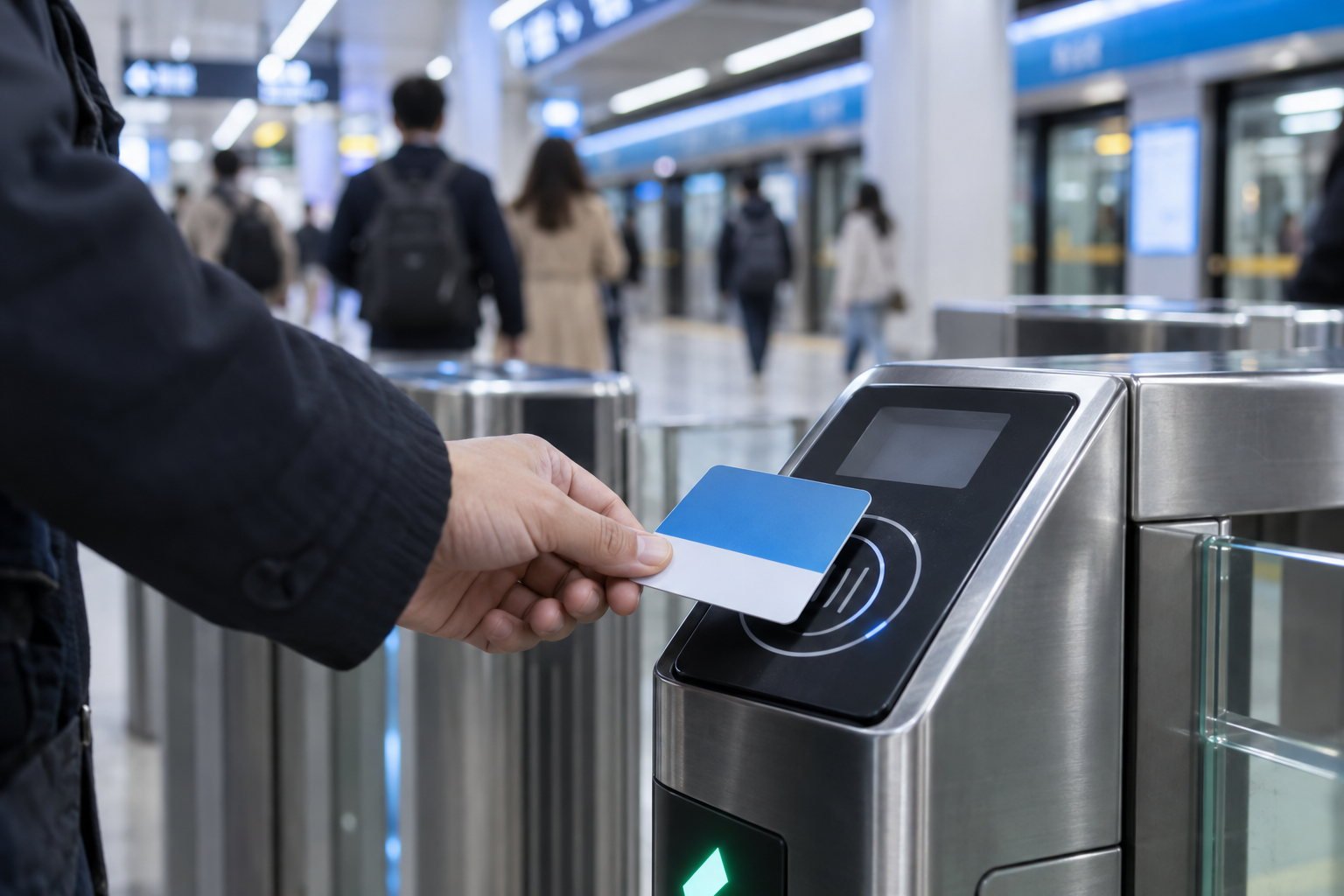
The short answer: An Octopus card is Hong Kong's stored-value payment card and costs about HK$150 to buy, made up of a HK$50 refundable deposit and HK$100 of stored value. It works on the MTR, buses, trams, ferries, the Peak Tram and in most convenience stores and supermarkets, and you get the deposit back when you leave.
Key takeaways
- Cost: about HK$150 – a HK$50 refundable deposit plus HK$100 of stored value.
- Buy it at the Airport Express station, any MTR customer service centre, or most 7-Eleven and Circle K stores.
- Accepted on the MTR, buses, green minibuses, trams, the Star Ferry and most ferries, the Peak Tram, in 7-Eleven, supermarkets and vending machines.
- Top-up minimum is HK$50. Keep at least HK$100 on the card to avoid running short mid-journey.
- Octopus allows a negative balance of about HK$35 for a single journey, so a small shortfall will not block you.
- Refunding within three months of purchase incurs a service fee of about HK$9.
- Each traveller needs their own card – you cannot tap one card for two people.
If you take one piece of practical advice about Hong Kong, take this: buy an Octopus card the moment you clear arrivals. It is the single thing that turns the city from mildly confusing into frictionless.
Octopus is a stored-value smart card that works as a payment method across nearly all public transport and a large share of everyday retail. It has been in use since 1997 and is embedded in the city in a way that contactless cards in most Western cities are not. You tap, it beeps, you move.
It pairs with the Hong Kong MTR guide, which covers the network itself. This post is only about the card: what it costs, where to get one, and how not to waste money on it.
What an Octopus card costs
There are two things you can buy, and for a short trip it matters which.
On-loan adult Octopus (the standard choice)
- About HK$150 to buy
- That splits into a HK$50 refundable deposit and HK$100 of stored value
- You hand it back at the end of your trip and get the deposit refunded
This is the one you want. You are effectively renting the card, not buying it.
Child and senior versions
- About HK$70
- Split into HK$50 deposit and HK$20 stored value
- Children aged 3 to 11 and seniors 65+ get reduced fares, which is why the deposit-weighted pricing is different
Sold-on-location versions
Some retail points sell pre-loaded cards with a fixed amount of value and no separate deposit structure. These are convenient but usually work out slightly worse value, and they are harder to refund.
Practical tip: If you are in Hong Kong for four days or more, buy the standard on-loan card and refund it at the airport on your way out. The whole loop costs you nothing but the fees below.
Where to buy one
You can buy an on-loan Octopus at:
- The Airport Express station at Hong Kong International Airport, on the arrivals level — this is the easiest option and where most visitors get theirs
- Any MTR customer service centre in any station
- 7-Eleven and Circle K convenience stores — most branches, though not all stock them
- MTR ticket machines at larger stations, which issue a version of the card
The airport option is the right one if you are arriving by air. Buy it before you get on the Airport Express and you can tap straight through.
Where Octopus is accepted
This is the part people underestimate. Octopus is not just a transit card.
Transport:
– MTR (all lines, including the Airport Express)
– Buses — KMB, Citybus and the others
– Green minibuses
– The Hong Kong Tramways
– Star Ferry and most other ferries
– The Peak Tram
– Taxis — some now accept it, but do not count on it
Retail and everyday:
– 7-Eleven, Circle K and most convenience stores
– Supermarkets including Wellcome and ParknShop
– Many cafes, bakeries and fast food chains
– Vending machines
– Car parks
– Some museums and attractions
In practice, Octopus covers transport, snacks, drinks, groceries and museum tickets. The main gaps are sit-down restaurants, taxis and market stalls, where you still want cash or a card.
If you are still deciding how to structure your days, the 3-day Hong Kong itinerary assumes you have a card from day one.
Practical tip: You can go a full day in Hong Kong on Octopus alone — trains, trams, ferries, breakfast, a museum, a coffee — and never open your wallet. That is the point of it.
How to top up
Top-ups are called “add value” locally, and the minimum is usually HK$50.
- MTR stations — machines and customer service centres
- Convenience stores — 7-Eleven and Circle K, minimum HK$50, cash
- Supermarkets — Wellcome, ParknShop
- Mobile app — if you use the digital version, you can top up with a credit card
One nice detail: Octopus allows a negative balance of up to about HK$35 on a single journey. So if you are slightly short on the way to the airport, the gate will still let you through once. It is a small piece of design that saves a lot of people from missing trains.
Practical tip: Keep at least HK$100 on the card. Running out mid-journey is the only way Octopus becomes inconvenient, and top-up points are not always right where you need them.
The digital version
Octopus exists as a phone wallet as well as a physical card.
- iPhone and Apple Watch: Octopus can be added to Apple Wallet and topped up with a foreign credit card. It works on all the same readers.
- Samsung and some Android phones: supported through Samsung Pay and Huawei Pay.
- Android via the Octopus app: works on NFC-capable phones, but device compatibility is narrower and region-dependent.
The digital version is genuinely convenient and means one less thing in your pocket. That said, for a first trip the physical card is more reliable — no compatibility questions, and it can be handed to another traveller in your group if needed.
Refunds and the fees nobody mentions
When you leave, you can refund the card and get your deposit and remaining value back. This happens at MTR customer service centres and at the airport.
Two fees to know about:
- A service fee of about HK$9 applies if you refund the card within three months of buying it. After three months, that fee does not apply.
- A reactivation fee of about HK$15 applies if a card has sat unused for a very long period — roughly three years — and needs to be reactivated.
For a normal tourist trip, the HK$9 fee is the one that applies. It is small enough not to change any decision.
Practical tip: If you plan to come back to Hong Kong within a few years, keep the card rather than refunding it. The stored value stays on it and you skip the queue on arrival next time.
Octopus versus a contactless bank card
Hong Kong accepts Visa and Mastercard contactless widely, including on the MTR at some gates. So do you actually need Octopus?
Yes, for these reasons:
– Foreign contactless cards often trigger a foreign transaction fee on every single tap, which adds up fast across 20 MTR journeys
– Octopus works on minibuses, trams, ferries and the Peak Tram, where card readers are not universal
– Octopus works in convenience stores and supermarkets without a minimum spend
– Some foreign cards are simply declined by Hong Kong transit readers
Use your card instead for: sit-down restaurants, hotels, larger purchases, and anything where you want the protection of a card transaction.
The honest answer is to carry both, plus a few hundred dollars in cash. The Hong Kong first-timer’s guide covers the wider payment picture, including how much cash you actually need.
Frequently asked questions
Is the Octopus card worth it for a short trip?
Yes, even for two days. It costs nothing net — you get the deposit back — and it removes the need to buy individual tickets at machines.
Can I use one Octopus card for two people?
No. Each person needs their own card, because the fare is deducted per tap. Sharing means one of you gets stuck at the gate.
How much should I load onto it?
About HK$200 for a three-day trip with normal MTR and ferry use, plus HK$100 if you want to use it for meals and snacks. HK$300–400 is a comfortable starting amount for a week.
Can I use Octopus in mainland China or Macau?
Not in mainland China, and not generally in Macau. Hong Kong runs its own payment system. If you are crossing to Shenzhen or Guangzhou, you will need Alipay, WeChat Pay or cash there.
What if I lose the card?
A registered Octopus can be reported and the balance transferred; an anonymous on-loan card cannot. If you are loading larger amounts, register the card through the Octopus app.
Does Octopus work at the airport?
Yes — on the Airport Express, the buses, and in the shops and restaurants at the airport. It does not, obviously, work outside Hong Kong.
Do I need to tap out as well as in?
On the MTR and Airport Express, yes, tap both in and out. On buses, trams and the Star Ferry, tap once on entry. Getting this wrong is how a small fare becomes a maximum fare.
Can I get a refund at the airport?
Yes, at the Airport Express station customer service desk. Allow a few minutes before you check in.