


Turpan’s Karez: The Underground Canals That Built a Desert
On the northern edge of Turpan, the desert is dotted with circles: old well mouths forty or fifty metres apart, marching from the gravel fans of the Tianshan foothills toward the green rim of the oasis. Nothing about them suggests water. Everything about them is water.
The Turpan karez is a 2,000-year-old underground irrigation network that carries snowmelt from the Tianshan Mountains beneath the desert floor and delivers it by gravity to vineyards in one of the driest, lowest basins on Earth. The most recent official count, from 2023, found 214 of its canals still flowing across 3,491 km of tunnel under the basin (Xinhua, 5 September 2023).
At jusha.travel, we love sharing tips that turn a good trip into a memorable one, so this guide stays practical: how the system works, which site to choose, what tickets cost this autumn, and how to get here from Urumqi.
What is a karez, and why did Turpan need one?
A karez is a gently sloping underground tunnel that taps groundwater at the foot of a mountain and carries it downhill to fields without a pump or a pipe. Turpan needed one because the basin receives about 16 mm of rain a year while losing roughly 3,000 mm to evaporation (Xinhua). Surface canals do not survive that arithmetic.
The Turpan Depression is the second-lowest land depression on Earth after the Jordan Valley, with Aydingkol Lake around 154 m below sea level. Water that reaches the basin has nowhere to drain.
How a karez works: four parts, one slope
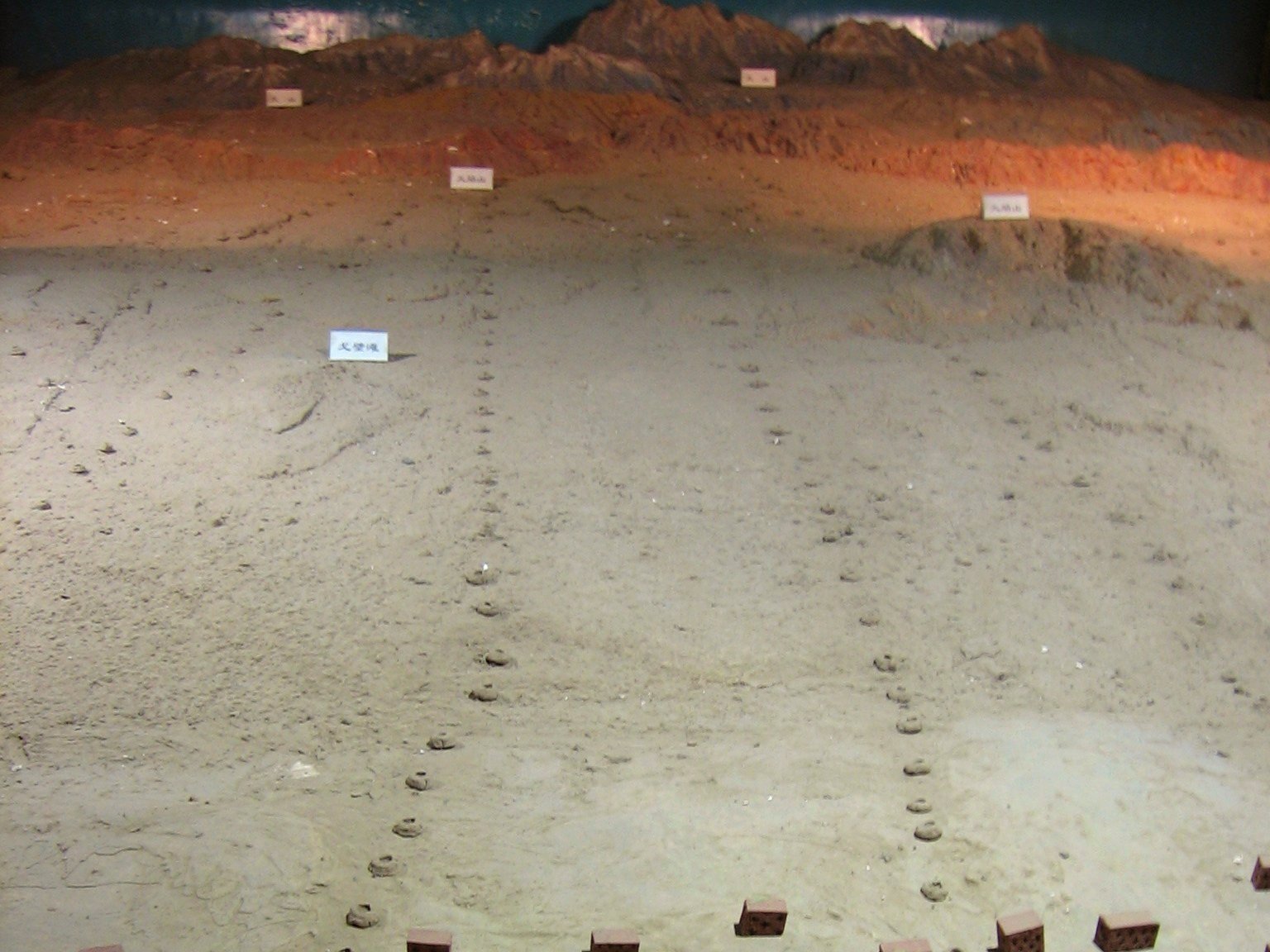
Every canal is assembled from the same four elements, laid along a single downhill gradient surveyed by oil lamp and rope. That gradient is tiny, often under one metre per kilometre — which is what keeps the water slow enough to arrive.
- Vertical shafts. Dug every 20–50 m to haul out spoil, ventilate the tunnel and lower workers.
- The underground channel. The tunnel itself, cut wide enough for one person, driven until it meets the water table.
- The open channel. Where the tunnel breaks the surface at the oasis edge.
- The reservoir. A small pond that holds water for irrigation and village use.
One karez can run 3–5 km and some exceed 100 km, while the shafts along a single line range from a dozen to well over a hundred (Tianshan Net, 27 September 2024).
Why the water has to travel underground
Turpan’s defining problem is exposure rather than drought: water left in the open evaporates, and any ditch fills with wind-blown sand within a season. Burying the channel answers both at once, and the spoil rings around each shaft double as windbreaks that keep grit out of the flow.
That design has held for two millennia. The Turpan karez ranks with the Great Wall and the Beijing–Hangzhou Grand Canal among China’s three great ancient engineering works, and the digging technique joined the national intangible heritage list in 2014.
Turpan’s karez network in numbers
The network is now a fraction of its historic size yet still among the largest of its kind anywhere, and the figures explain why engineers study it rather than merely photograph it.
| Measure | Figure | Source |
|---|---|---|
| Canals in Turpan | 997 | Xinhua, Sep 2023 |
| Still flowing | 214 | Xinhua, Sep 2023 |
| Total length | 3,491.74 km | Xinhua, Sep 2023 |
| Length at peak | 5,272 km | People’s Daily, Oct 2024 |
| Annual runoff | 114 million m³ | Tianshan Net, Sep 2024 |
Where to see a karez: three sites compared
Three developed attractions sit around Turpan and they are not interchangeable: one takes you underground, one explains the culture above ground, one sits beside Jiaohe. All are cheap and none needs a full day.
| Site | Ticket | Best for | Allow |
|---|---|---|---|
| Karez Paradise | 40 CNY | Descending into the tunnel | 1–1.5 h |
| Karez Folk Garden | 40 CNY | Uyghur village life | 1 h |
| Jiaohe Post Karez Source | 40 CNY | Paired with Jiaohe | 45 min |
Prices come from Ctrip and Tongcheng listings checked in October 2026; a combined pass covering eleven Turpan sites, including all three, sells for 208 CNY.
Karez Paradise: 60 metres down to the water table
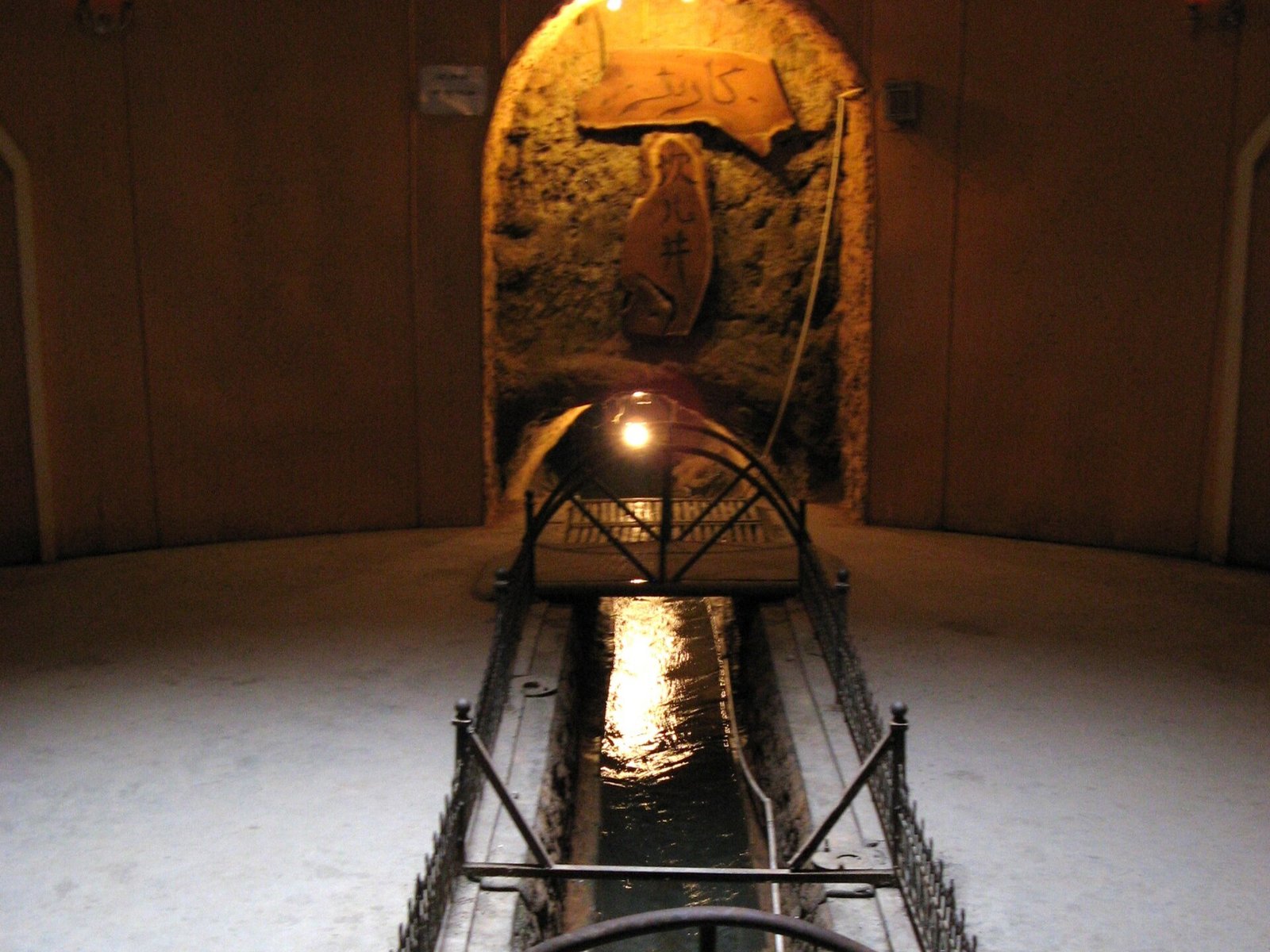
Karez Paradise is the site most visitors mean when they say they have seen the system, because you actually walk into it. An elevator drops about 60 m into a lit tunnel where Tianshan meltwater runs past your feet (Xinhua, 2023).
Above ground it holds a small museum, a scale model of the network and a shaded line of mulberry trees. Tickets are 40 CNY, or 20 CNY for students and over-60s, and the gates open 08:30–20:00 (Ctrip listings, October 2026). Go early: the tunnel is cool, the car park is not.
Jiaohe: the Silk Road city that drank from the same water
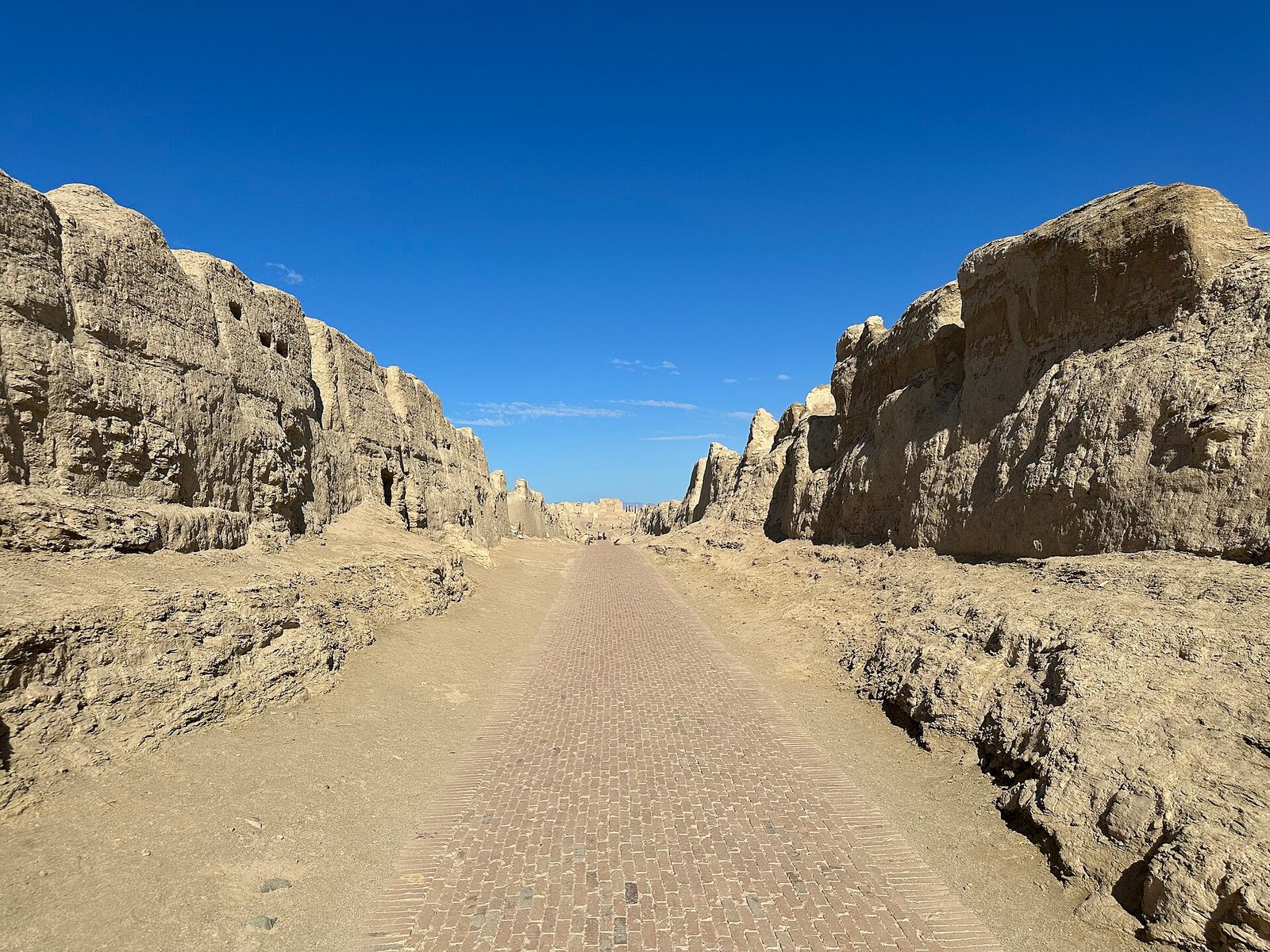
Jiaohe is a 2,000-year-old earthen city on a leaf-shaped plateau between two rivers, and the clearest place to see what that water paid for. The city joined the UNESCO Silk Roads listing in 2014 alongside Gaochang, the basin’s other great oasis capital.
Walking the Central Avenue is the point: monasteries, workshops and homes are cut down into the plateau rather than built up from it. There is no shade, so come at opening time or in the last two hours of light.
Entry is 70 CNY, or 95 CNY with the shuttle, and the site is open 09:30–19:30 (Tongcheng listing, October 2026). For wider context, our post on tracing Xi’an’s Silk Road legacy is a good start.
What the water grows: grapes and the chunche
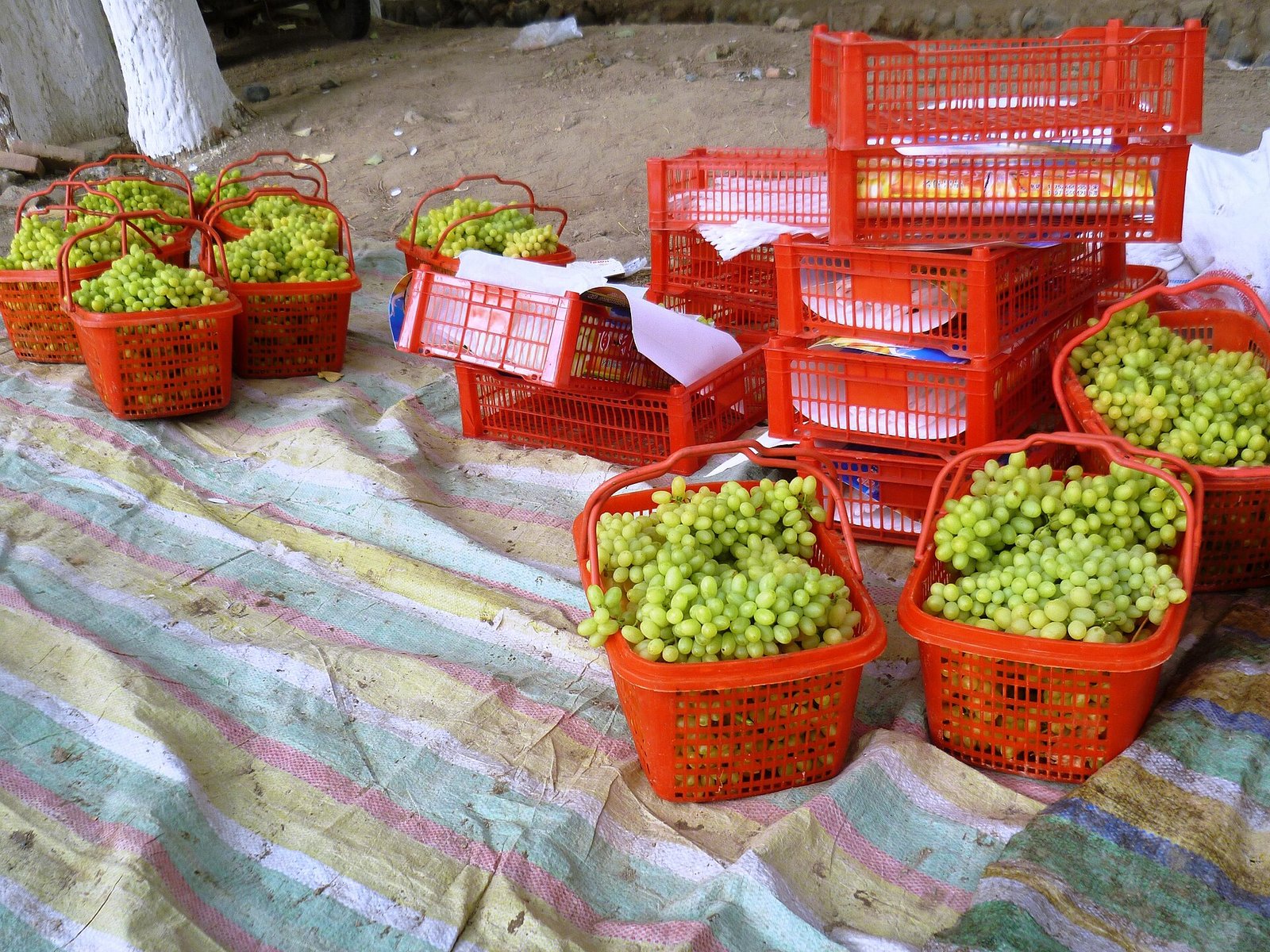
Turpan’s grapes are the visible dividend: more than 100 varieties grow here, the 2025 harvest reached 1.71 million tonnes, and the basin supplies most of China’s seedless raisins.
Look for the chunche on the skyline — square brick drying houses with pierced walls, stacked on rooftops and field edges. Air moves through the holes, grapes hang inside for about forty days, nothing is pressed or heated. Grape Valley, 11 km northeast of town, shows trellises, drying houses and a very commercial village in one stop; major booking platforms list entry as free with a 23 CNY shuttle (October 2026).
When to go: Turpan month by month
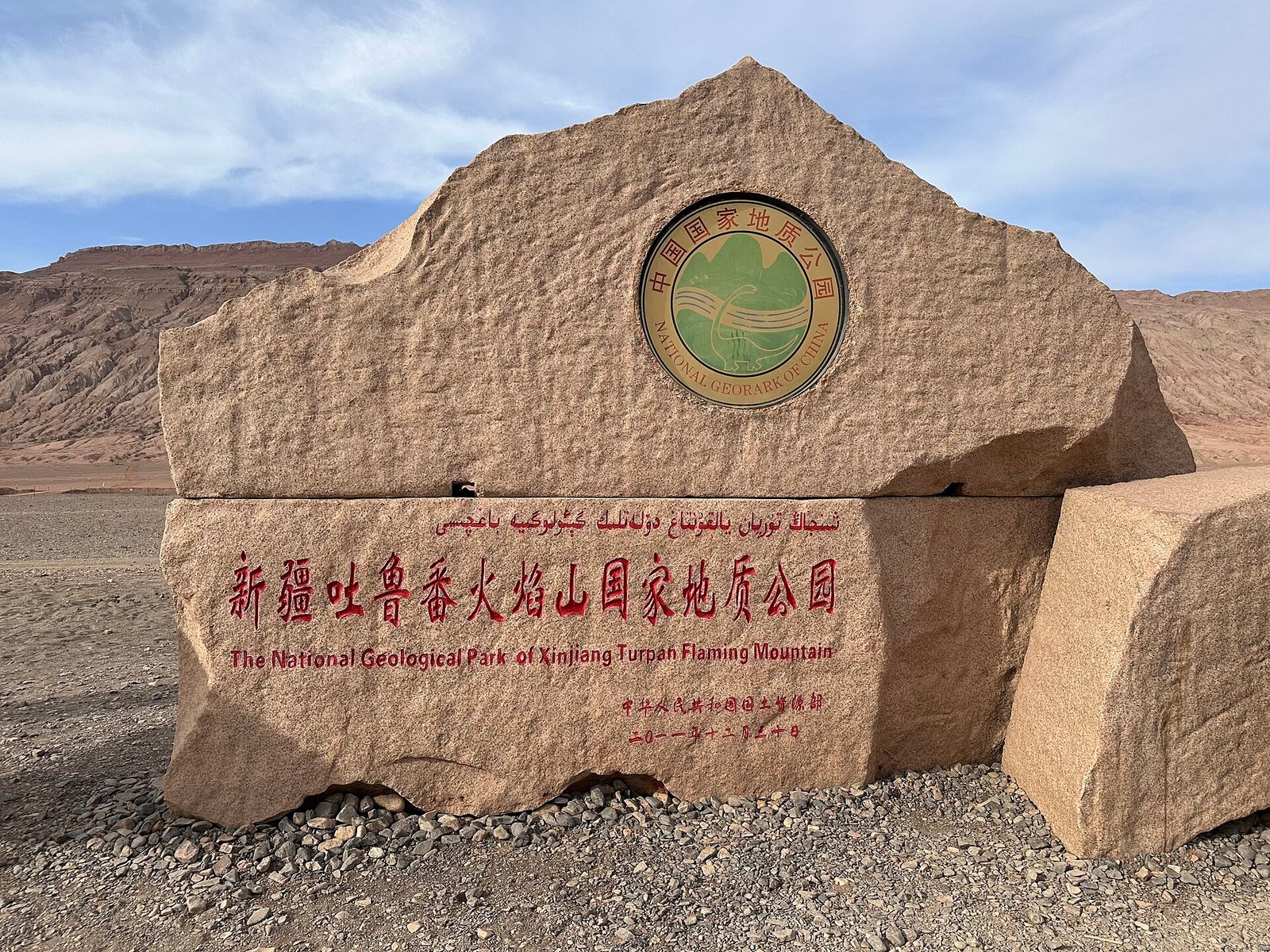
Late September and October are the most comfortable weeks in Turpan, with clear skies, light wind and temperatures that make open ruins walkable. The harvest peaks in August and September, so October trades fruit for comfort.
| Month | Average high | What it means |
|---|---|---|
| August | 33 °C | Harvest, punishing at midday |
| September | 27 °C | Peak grapes, still hot |
| October | 19 °C | Best all-round window |
| November | 7 °C | Quiet, cold nights |
Is the karez system dying?
The system is not dying, but it came close: tube wells sunk from the 1970s onward lowered the water table, hundreds of tunnels ran dry, and the flowing total fell to a fraction of its peak.
Protection since 2009 has clawed part of that back. Turpan has spent close to 250 million CNY restoring more than 200 canals (Xinjiang Daily, 21 September 2026), and in September 2024 the system entered the ICID World Heritage Irrigation Structures list (People’s Daily, 14 October 2024). In 2025 the Turpan Karez Agricultural System joined China’s GIAHS candidate list.
Getting there and getting around
Turpan North station sits on the Lanzhou–Xinjiang high-speed line, about 167 km and one hour from Urumqi, with more than twenty departures a day and second-class seats at 51.5 CNY (12306 timetable, 30 October 2026).
A taxi into town costs roughly 25 CNY, but the sites are scattered, so hire a car for the day or join a shared tour. Daily life in Xinjiang also runs about two hours behind Beijing time: a restaurant advertising a noon opening may not serve until two.
Practical tips for visiting the karez sites
- Carry two litres of water each; sweat evaporates before you notice it.
- Visit Jiaohe or Gaochang before 11:00 or after 17:00 — there is no shade.
- Bring cash for village stalls; card readers often fail.
- Cover shoulders and knees at the Emin Minaret, still an active place of worship.
- Buy raisins by weight in the bazaar, not at scenic gates.
A workable two-day plan
- Day one, morning: Karez Paradise at 08:30, then the Folk Garden.
- Day one, afternoon: Jiaohe in the last two hours of light, when the mud walls turn gold.
- Day two, morning: Gaochang and the Bezeklik caves along the Flaming Mountains road.
- Day two, afternoon: Grape Valley and the bazaar, then the evening train to Urumqi.
Final thoughts
Turpan’s karez is the rare piece of ancient engineering you can still drink from. Standing in that lit tunnel with meltwater at your ankles, the arithmetic stops being abstract: 16 mm of rain against 3,000 mm of evaporation, and a line of wells dug by hand to close the gap.
If the desert oases pulled you toward Xinjiang, our guides to visiting Dunhuang’s Mogao Caves, Kashgar’s Uyghur bazaar and China’s desert adventures pick up where this leaves off. Heading east? Shapotou makes a fine counterpoint.
Frequently asked questions
What is a karez in Turpan?
A karez is an underground irrigation tunnel that carries mountain groundwater downhill by gravity to desert fields, and Turpan’s network of 997 canals is the largest of its kind in China. Each canal combines vertical shafts, a buried channel, an open channel and a pond.
How much does it cost to visit the karez sites?
All three karez sites charge 40 CNY for adults and 20 CNY for students and over-60s as of October 2026. A combined pass covering eleven Turpan sites sells for 208 CNY.
How do I get to Turpan from Urumqi?
High-speed trains run from Urumqi to Turpan North in about one hour across 167 km, second-class seats cost 51.5 CNY, and there are more than twenty departures a day as of October 2026.
Can you go inside a karez tunnel?
Yes, at Karez Paradise, where an elevator descends about 60 m to a lit tunnel with meltwater running through it. The site opens 08:30–20:00 and adult entry is 40 CNY; the tunnel is cool, so bring a layer.
When is the best time to visit Turpan?
October is the best all-round month, with average highs near 19 °C and clear, windless days that make the open ruins at Jiaohe and Gaochang walkable. September is hotter at 27 °C but coincides with the harvest.
Are the karez canals still in use?
Yes, 214 of Turpan’s 997 canals still carry water, irrigating roughly 6,600 hectares as of 2023. Restoration since 2009 has cost close to 250 million CNY and revived more than 200 canals.