


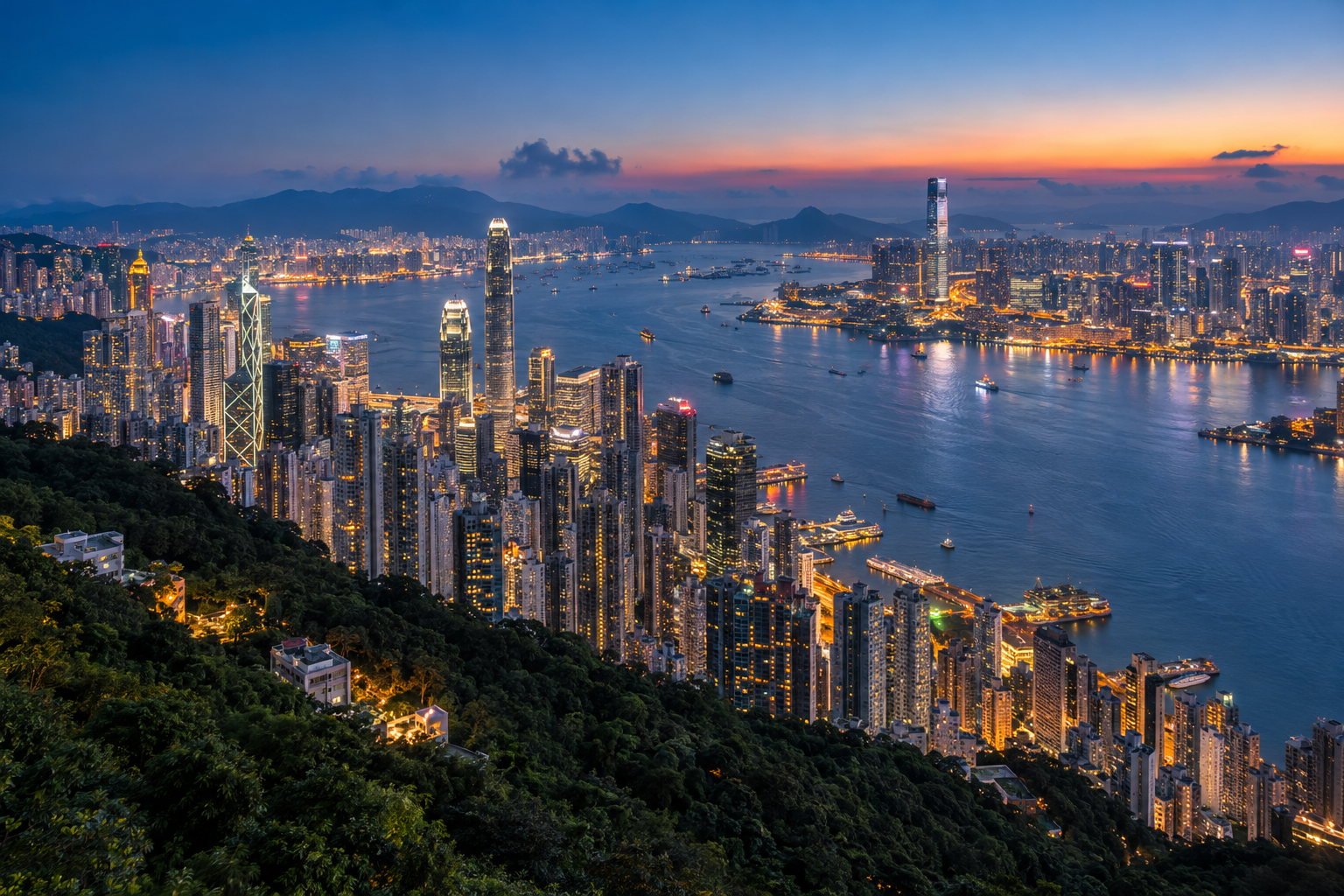
The short answer: Hong Kong rewards a first visit of three to five days, and the best window is October to December, when temperatures sit at 20-27C and the harbour is at its clearest. A comfortable mid-range day costs roughly HK$1,200-1,800 per person including a hotel, and an Octopus card covers almost all transport and small purchases.
Key takeaways
- Best time to visit: October to December. Avoid June to September (typhoon season) and Lunar New Year, when hotel rates triple.
- Typical budget: HK$1,200-1,800 per person per day mid-range, or HK$500-700 on a tight budget.
- Where to stay: Tsim Sha Tsui in Kowloon for the skyline view and best food value; Wan Chai or Causeway Bay on Hong Kong Island.
- Get an Octopus card on arrival: about HK$150, including a HK$50 refundable deposit.
- The Star Ferry from Central to Tsim Sha Tsui costs HK$5-7 and is the best-value sightseeing in the city.
- Most Western passports enter visa-free for 30 to 90 days. Hong Kong immigration is separate from mainland China.
- Budget three days minimum. Under two days you spend most of it in transit.
Hong Kong is one of the easiest big cities in Asia to visit and one of the easiest to get wrong. Everything works — the trains run on time, the signs are in English, the food is extraordinary — and yet most first-timers come home having spent too much, eaten in the wrong places, and queued for two hours to see a view they could have had for free.
This guide is the version I wish someone had given me. It covers the decisions that actually matter: when to come, where to base yourself, how to pay for things, and what a realistic day costs. If you already know your dates and just want a day-by-day plan, jump to the 3-day Hong Kong itinerary.
When to visit Hong Kong
October to December is the answer. Humidity drops, the sky clears, temperatures sit between 20°C and 27°C, and the harbour looks like the postcard. If you are choosing one window, choose late October or November.
March to April is the second-best option — warm and green, with occasional fog that can ruin skyline views.
Avoid June to September if you have a choice. This is typhoon season, and the city gets 80% of its annual rainfall between May and September. A typhoon signal 8 shuts down ferries, the Peak Tram, and most flights. It is not dangerous, but it will eat your itinerary.
Avoid Lunar New Year for cost reasons, not weather. Hotel rates triple, and many small restaurants close for the week.
Practical tip: Typhoon season runs roughly May to November, with the peak in July to September. If you travel then, buy travel insurance that explicitly covers typhoon-related cancellations, and keep your first and last days flexible.
Where to stay: neighbourhood by neighbourhood
Hong Kong has three practical bases for a short trip, and picking the wrong one costs you an hour of transport every day.
Tsim Sha Tsui (Kowloon)
The best choice for a first visit. You get the skyline view looking back at Hong Kong Island, the museums, the Star Ferry terminal, and the densest concentration of affordable food in the city. Hotel rooms are small but cheaper than the Island side.
Central, Sheung Wan and Wan Chai (Hong Kong Island)
Better if you are in the city for business, or if you want the tram, the escalator, and the bar districts on your doorstep. Expect to pay 30–40% more for the same room size.
Causeway Bay and North Point (Hong Kong Island)
Where locals shop and eat. Cheaper than Central, extremely well connected by MTR, and much less touristy. Good middle ground.
Kennedy Town (Hong Kong Island)
The quiet, cheaper, residential option at the western end of the Island line. Fifteen minutes on the MTR from Central, with a genuine neighbourhood feel and better-value accommodation.
Practical tip: Ignore the hotel’s claimed “walking distance to MTR”. Check it yourself on a map. In Hong Kong, a five-minute walk that involves crossing a major road or climbing a hill in July heat is not a five-minute walk.
What things actually cost
These are mid-range figures in Hong Kong dollars, per person. Prices move, so treat them as planning numbers rather than gospel.
| Item | Typical cost (HK$) |
|---|---|
| MTR journey, cross-harbour | 10–15 |
| MTR journey, short hop | 4–8 |
| Star Ferry, Central to Tsim Sha Tsui | 5–7 |
| Peak Tram, return | about 88 |
| Budget hotel room, per night | 400–700 |
| Mid-range hotel room, per night | 900–1,600 |
| Dim sum meal | 80–180 |
| Bowl of noodles at a dai pai dong | 40–60 |
| Coffee, chain café | 30–45 |
| Museum entry, most public museums | 0–20 |
| Airport Express, single to Central | about 115 |
A comfortable mid-range day — hotel, three meals, transport, one paid attraction — lands around HK$1,200–1,800 per person. A tight budget version, staying in a hostel or a very small room and eating local, is achievable at HK$500–700. If you want concrete properties rather than ranges, there is an updated list of Hong Kong hotels by budget on this site.
Practical tip: Hong Kong has almost no tipping culture. A 10% service charge is usually already on the bill in sit-down restaurants. If there is no service charge, rounding up is generous enough.
How to pay for things
This is the single most common source of first-timer friction, and the answer is simpler than the internet makes it sound.
- Get an Octopus card on arrival. Buy it at the airport or any MTR customer service centre. It covers the MTR, buses, trams, the Star Ferry, and most convenience stores. This alone solves 80% of your payment problems. The full Octopus Card guide explains where to buy it, what it costs and how to get your deposit back.
- Use a contactless bank card or phone wallet for larger purchases. Visa and Mastercard are accepted almost everywhere that is not a market stall.
- Carry some cash. HK$500 in small notes covers taxis, markets, and the small noodle shops that still do not take cards.
- Do not rely on cash-only. Some places genuinely will not take notes for small amounts.
Hong Kong is a separate financial system from mainland China. Alipay and WeChat Pay work, but they are not the default the way they are across the border — Octopus and cards are.
Practical tip: Octopus now works as a phone wallet as well as a physical card. If you have an iPhone, you can add it to Apple Wallet and top up with a foreign card. That said, the physical card is more reliable for a first trip and doubles as a handy souvenir.
Getting around
The MTR is the answer to almost every transport question in Hong Kong. It is fast, cheap, air-conditioned, signposted in English, and runs from roughly 05:30 to 01:00. The Hong Kong MTR guide covers the ten lines, real fares and every airport transfer option.
For the harbour crossing, take the Star Ferry rather than the MTR at least once. It costs a few dollars, takes eight minutes, and is the best-value thing in the city.
Taxis are cheap by international standards but become a bad idea at peak hours and in the Cross-Harbour Tunnel. Trams on Hong Kong Island are slow, historic, and cost about HK$3 — ride one at least once.
Common first-timer mistakes
- Treating Hong Kong Island and Kowloon as one place. They are separated by a harbour and the crossing matters. Split your days by geography.
- Queuing for the Peak Tram at 10am. The queue is 45 minutes by mid-morning and almost nothing before 8:30am.
- Booking a hotel without checking the MTR walk. See above.
- Assuming English is universal. It is widely spoken in hotels, MTR, and Central, but much less so in neighbourhood restaurants and markets.
- Over-scheduling. Hong Kong’s distances are small but its verticality and crowds are not. Three well-chosen things a day is a full day.
Practical tip: Buy your Peak Tram ticket online the night before, then arrive early. The combo ticket including Sky Terrace 428 is worth it only if the sky is clear — check the view from the street before you commit.
Do you need a visa?
Most visitors from the US, UK, EU, Australia, Canada and New Zealand enter Hong Kong visa-free for 30 to 90 days depending on nationality. Your passport needs at least one month validity beyond your stay.
Note that Hong Kong immigration is separate from mainland China. Entering Hong Kong does not use a mainland Chinese visa, and the rules are different. If you are continuing to the mainland, sort that separately.
Practical tip: Check your own nationality’s requirement on the Hong Kong Immigration Department website before booking. The rules are specific per country and change without much notice.
Frequently asked questions
Is Hong Kong expensive?
It can be, but it does not have to be. Public transport is cheap, most museums are free or near-free, and local food is genuinely affordable. The expense is accommodation. Budget travellers who accept a small room can do Hong Kong comfortably for under HK$700 a day.
Is Hong Kong safe?
Yes. Violent crime against tourists is rare, and the city is safe to walk at night, including in the market districts. The realistic risks are pickpocketing in crowded areas and getting caught out by a typhoon.
How many days do I need in Hong Kong?
Three days covers the essentials properly. Five days lets you add Lantau, Sai Kung, and a slower pace. Anything under two days means you will spend most of it in transit.
Do I need to speak Cantonese?
No, but people appreciate an attempt. English is widely understood in anything tourist-facing. Having the Chinese characters for your destination on your phone helps enormously in taxis.
Can I drink the tap water?
It is technically treated and safe, but most residents drink bottled or boiled water. Bottled water is cheap everywhere.
When is the cheapest time to visit?
Late January to February, after New Year but before Lunar New Year, and again in May. Avoid October (peak season) and Lunar New Year (peak pricing).
Is Hong Kong a good base for mainland China?
Yes — it is one of the best. Flights and high-speed rail connections to the mainland are excellent, and it is an easy place to acclimatise before heading north.
What should I not miss?
The Star Ferry, the Victoria Harbour skyline at night, dim sum at a proper morning teahouse, and one ride on the tram through Wan Chai and Causeway Bay.