


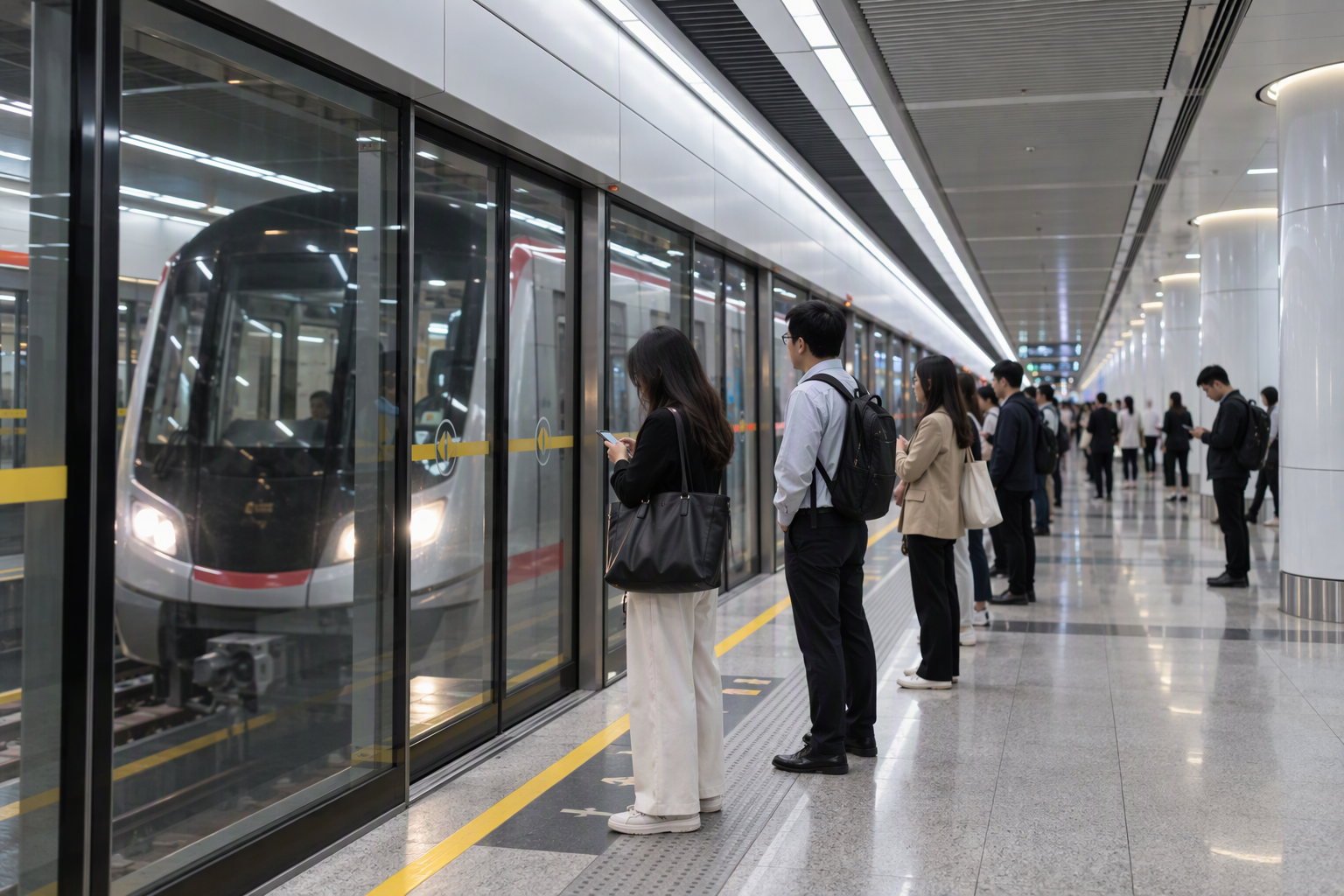
The short answer: The Hong Kong MTR is ten lines running roughly 05:30 to 01:00, with urban fares of about HK$4-12 and the Airport Express taking about 24 minutes to Hong Kong Station for roughly HK$115. It is bilingual throughout and covers almost every journey a visitor needs; Octopus is the cheapest way to pay.
Key takeaways
- Ten lines. The Tsuen Wan Line (Central to Tsim Sha Tsui) and the Island Line cover most of a first trip.
- Fares: HK$4-8 for a short hop, HK$10-15 cross-harbour, about HK$28 from Central to Tung Chung.
- Runs about 05:30 to 01:00. Last trains leave major stations between 00:30 and 01:00, and there is no overnight service.
- Airport Express: about 24 minutes to Hong Kong Station, roughly HK$115, trains every 10 minutes.
- In-town check-in at Hong Kong and Kowloon stations lets you drop bags hours before your flight.
- Airport buses (the A-routes) cost around HK$40 but take 40-70 minutes depending on traffic.
- Avoid 08:00-09:30 and 17:30-19:00. Note your exit letter in advance – MTR stations are large.
The MTR is the reason Hong Kong works. It carries well over four million journeys a day across ten lines, runs from early morning to past midnight, is signposted in English everywhere, and costs less than almost any comparable metro system in the world.
For a visitor, the useful mental model is this: the MTR solves almost every transport question in the city, and the remaining questions are answered by the Star Ferry, a tram, a bus, or a taxi. Learn the MTR and Hong Kong becomes small.
If you are still at the planning stage, start with the Hong Kong travel guide for first-timers. This post assumes you are already arriving and just need to move around.
The ten lines, in plain terms
You do not need to memorise the network. You need to know which lines go where you are likely to go.
| Line | What it is for |
|---|---|
| Island Line | Hong Kong Island west to east: Kennedy Town, Central, Wan Chai, Causeway Bay, North Point |
| Tsuen Wan Line | The main cross-harbour line: Central to Tsim Sha Tsui, then north through Kowloon |
| Kwun Tong Line | Eastern Kowloon: Yau Ma Tei, Mong Kok, Wong Tai Sin, Kwun Tong |
| Tuen Ma Line | A long east–west line through the New Territories, linking Wu Kai Sha to Tuen Mun |
| Tung Chung Line | Getting to Lantau, Tung Chung and the Ngong Ping cable car |
| Airport Express | Dedicated airport line to Hong Kong, Kowloon and Tsing Yi stations |
| Tseung Kwan O Line | Eastern New Territories and Tseung Kwan O |
| East Rail Line | North to the mainland border at Lo Wu and Lok Ma Chau |
| South Island Line | Down to the south of Hong Kong Island: Ocean Park, Wong Chuk Hang, Lei Tung |
| Disneyland Resort Line | The short branch to Disneyland, from Sunny Bay |
The two lines that matter most on a first trip are the Tsuen Wan Line (the harbour crossing between Central and Tsim Sha Tsui) and the Island Line. Between them they cover most of what a visitor wants. The 3-day Hong Kong itinerary uses almost nothing else.
Practical tip: The MTR is colour-coded on every map and sign. If you remember that the Island Line is blue and the Tsuen Wan Line is red, you can navigate most of central Hong Kong without thinking.
What it costs
Fares are distance-based and cheap. Approximate adult fares:
| Journey type | Fare (HK$) |
|---|---|
| Short hop, one or two stops | 4–8 |
| Typical urban journey | 8–12 |
| Cross-harbour, Central to Tsim Sha Tsui | 10–15 |
| Long journey, e.g. Central to Tung Chung | 20–28 |
| Light Rail, New Territories | 5–8 |
Compare that to a taxi, which is around HK$30 just to start. For almost every journey in the urban core, the MTR is both faster and cheaper.
Children under 3 travel free. Children 3 to 11 and seniors 65+ pay reduced fares with a child or senior Octopus. There is no separate ticket needed in most cases — you just tap.
Practical tip: The single biggest way to overspend on the MTR is buying single-journey tickets. Use an Octopus card instead — it is cheaper per journey, works on buses and ferries too, and removes the ticket-machine queue entirely.
Operating hours
The MTR runs roughly 05:30 to 01:00, with the last trains leaving major stations shortly after midnight. Exact times vary by line and station, and the first and last trains on the outer lines are earlier and later respectively.
The Airport Express runs from about 05:50 to 01:15 from the airport.
Three things worth knowing:
- The last train is earlier than you think on some lines. If you are out late in Lan Kwai Fong, check the time rather than assuming.
- Trains are extremely frequent — every two to four minutes at peak, five to eight minutes off-peak. You will almost never wait long.
- There is no night service on the MTR. After the last train, it is taxis or the night buses (the N-prefixed routes).
Getting from the airport to the city
This is the decision that matters most on arrival, because it is the one you make while jet-lagged. There are four options and they suit different trips.
Option 1: Airport Express
The train from the airport to Hong Kong Station in Central. Fast, quiet, and designed for luggage.
- Journey time: about 24 minutes to Hong Kong Station, 21 to Kowloon
- Cost: roughly HK$70 to Tsing Yi, HK$105 to Kowloon, HK$115 to Hong Kong. Return and group tickets reduce this significantly
- Trains: every 10 minutes
- Best for: anyone staying on Hong Kong Island, or anyone who values speed above cost
Its best feature is in-town check-in at Hong Kong and Kowloon stations, where most major airlines will take your bags hours before your flight. On the way home, that turns your last day into a full day.
Option 2: Airport buses (A routes)
City buses that run from the airport to all over Hong Kong.
- Journey time: 40 to 70 minutes depending on destination and traffic
- Cost: roughly HK$40 per journey
- Best for: budget travellers, and anyone whose hotel is on a direct A-route
The A-routes are the value option and the view on the way in over the bridges is a decent introduction to the city. They are slower and less predictable than the train.
Option 3: Taxi
Readily available outside arrivals, colour-coded by destination area (red for urban Hong Kong, green for the New Territories, blue for Lantau).
- Journey time: 30 to 50 minutes
- Cost: roughly HK$300 to HK$400 to the urban core, plus tunnel and luggage charges
- Best for: groups of three or four, anyone with a lot of luggage, and late arrivals
For one person it is expensive. For four people splitting it, a taxi is often cheaper than four Airport Express tickets. If you are heading straight for Lantau rather than the city, see the Lantau Island guide instead — the Tung Chung Line is your route.
Option 4: MTR via Tung Chung
Take a bus to Tung Chung and then the Tung Chung Line.
- Cheapest overall, but involves a bus transfer with luggage
- Only worth it if you are already heading somewhere on the Tung Chung Line
Practical tip: If you take the Airport Express, buy your ticket or use Octopus on arrival and look for the free in-town check-in on your departure day. It is the single most useful airport service Hong Kong offers.
Using the MTR without speaking Cantonese
The MTR is one of the easiest transit systems in Asia for a non-Chinese speaker.
- Every sign is bilingual in Chinese and English, including platform signs and exit signs
- Every station is announced in Cantonese, Mandarin and English
- Exits are numbered (A1, A2, B, etc.) with street-level maps at every exit — noting your exit number in advance saves a lot of walking
- Ticket machines and Octopus readers have English interfaces
The one genuinely useful habit is to check your exit letter before you arrive. MTR stations are large; the wrong exit can add 10 minutes and a road crossing.
Practical tip: Google Maps works well for MTR routing in Hong Kong, but it is often slower than local apps. The official MTR Mobile app and Citymapper both give better platform and exit-level directions.
Practical fares and tickets worth knowing
- Single journey tickets are sold at machines for cash or Octopus. They are more expensive per trip than tapping a card.
- Airport Express Travel Pass bundles airport transfers with a few days of unlimited MTR travel. Worth checking if your trip is short and airport-heavy.
- Tourist Day Pass gives unlimited MTR travel for a day, but only pays off if you are making many journeys. Most visitors do not.
- MTR City Saver and monthly passes exist for residents; they are rarely relevant for tourists.
For a normal three-to-five-day visit, Octopus plus the Airport Express is the combination that works.
Frequently asked questions
Is the MTR easy for tourists?
Yes. It is bilingual throughout, clearly signposted, and staffed. It is widely considered one of the most tourist-friendly metro systems in the world.
Should I take the Airport Express or a bus?
Airport Express if you are staying on Hong Kong Island or want speed and luggage space. A bus if you are on a budget or your hotel is on a direct A-route. Taxi if there are four of you.
Do I need a separate ticket for the Airport Express?
No — Octopus covers it, and there are dedicated Airport Express tickets and group tickets if you prefer. Group tickets are cheaper per person from two travellers up.
How late does the MTR run?
Last trains leave major stations shortly after midnight, typically between 00:30 and 01:00. There is no overnight MTR service; use taxis or night buses after that.
Can I use Octopus on buses and the Peak Tram?
Yes. Octopus works on buses, trams, most ferries, the Peak Tram and the green minibuses.
What is the Light Rail?
A separate light rail system in the western New Territories around Tuen Mun and Yuen Long. Separate fares, separate network. Not relevant unless you are going there.
Is the MTR crowded?
Very, at peak times on the Island Line, Tsuen Wan Line and in Mong Kok. Avoid 08:00–09:30 and 17:30–19:00 if you can.
Do I need to pay for luggage on the MTR?
No, but large luggage is not allowed on some lines at some times, and it is discouraged on busy trains. The Airport Express is designed for it; the rest of the network less so.